
Exterior house painting in East Sacramento is not the same job as painting a tract home in Elk Grove or a stucco build in Natomas. The East Sac neighborhoods between Alhambra Boulevard and the Fab 40s are dominated by pre-1940 architecture — Queen Anne and Folk Victorians, California Craftsman bungalows, Tudor Revivals, Colonial Revivals, and Mediterranean cottages — and each style has its own historically appropriate palette, trim detailing, and prep requirements that a generic repaint will fundamentally get wrong.
Layer Sacramento's Central Valley sun, the 45 triple-digit days recorded in 2024 (CBS Sacramento, 2024), and the unofficial but very real color conventions of neighborhoods like the Fabulous 40s, and exterior painting in East Sacramento becomes an architecture-first job. Choose wrong and a historic Victorian looks like a stucco tract house with fussy trim. Choose right and the home reads as one of the best-preserved examples of its period on the block.
This guide walks through the three dominant historic styles in East Sac, the color palettes that work for each, the real 2026 cost range for professional exterior painting in this part of Sacramento, HOA-style color rules in the Fab 40s, and the Sacramento-specific prep and paint choices that keep a repaint looking sharp for a full decade.
Why East Sacramento Exterior Painting Is a Different Job
East Sacramento is roughly a century of California residential architecture inside a three-square-mile envelope. The housing stock runs from 1890s Folk Victorians around McKinley Park, through the Craftsman building boom between 1910 and 1925 along H Street and J Street, into the custom Tudor, Colonial Revival, and Mediterranean Revival homes built in the Fabulous 40s neighborhood between 1935 and 1950.
Three factors make exterior painting here different from a typical Sacramento suburb:
- Architectural period matters. A 1912 Craftsman should not be painted in the same palette as a 1940 Colonial Revival, and neither should be painted like a 1997 production home. Period-correct color reads as intentional preservation and supports resale value.
- Wood substrate dominates. Most East Sac homes are painted clapboard, lap siding, or shingle over 80- to 130-year-old redwood or Douglas fir. That substrate behaves differently under a repaint than fiber-cement or stucco and requires different prep.
- The Fab 40s has color conventions. There is no formal HOA, but the Fabulous 40s Neighborhood Association, the neighborhood's character-defining palette history, and buyer expectations at resale all push homeowners toward a recognizable range of historic paint colors.
On top of all that, East Sacramento sits in the same Central Valley heat bowl as the rest of the city. Sacramento averages 73 days per year above 90°F (NOAA Western Regional Climate Center, 2025), and summer UV intensity hits index 9–10 on clear days (EPA UV Index, 2025). A historic color palette still has to survive a climate that is happy to chalk, fade, and crack a cheap paint job within four summers.

The Three Historic Styles That Define East Sacramento Exteriors
Paint color starts with architecture. Before picking a Sherwin-Williams fan deck or a Benjamin Moore swatch, identify the style of the house and the color palette that period supports.
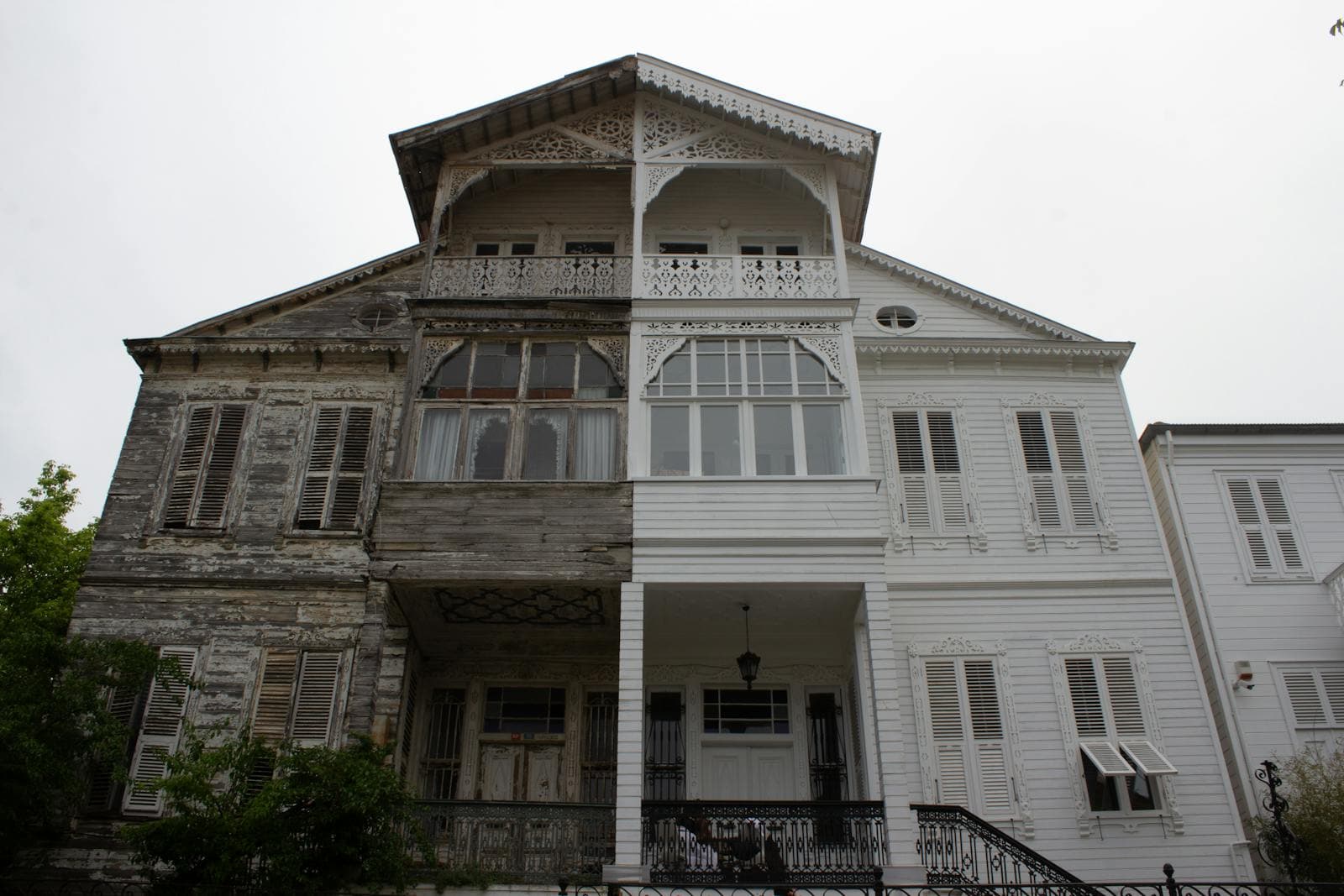
Victorian (Queen Anne, Folk Victorian, Eastlake) — 1890 to 1910
Victorians in East Sac are concentrated near McKinley Park, the J Street corridor east of Alhambra, and pockets of Newton Booth on the western edge. Identifiers include asymmetrical facades, turrets or bay windows, decorative gable brackets, patterned shingle siding in the gable ends, spindle work on porches, and multiple roof pitches.
Period-correct Victorian paint means three to five colors, not the two colors most modern homes wear. The classic Painted Lady scheme uses:
- A field color on the main siding body (usually the darkest or mid-tone)
- A trim color on window surrounds, fascia, and porch rails (usually lighter, high contrast)
- A sash color on window frames themselves (often the same as accents, picks up detail)
- An accent color on spindles, gable details, and brackets (third and sometimes fourth color)
- A door color (often a fifth color — deep red, bottle green, or black)
Period Victorian palettes typically live in the historic earth-tone range — deep olive greens, muted sage, terra cotta, burnt sienna, dusty brick red, mustard yellow, Prussian blue, and warm cream or buttermilk. Pure white was uncommon; ivories, bone, and warm off-whites read more accurate.

A Victorian painted in a single body color with white trim loses virtually all of its period character. The trim-to-field contrast is the whole point — spindle work, brackets, and dentil details only read as historic when the paint picks them out.
Craftsman Bungalow — 1910 to 1925
Craftsman bungalows are the single most common historic style in East Sacramento, lining the 30s streets between J and M, running north into the Marshall School neighborhood, and scattered through Newton Booth and McKinley Park. Identifiers include low-pitched gabled roofs with exposed rafter tails, decorative knee braces or brackets, tapered porch columns on stone or brick pedestals, wide front porches, banks of divided-light windows, and shingle or lap siding often combined.
Craftsman color philosophy is the opposite of Victorian. Where Victorians celebrate contrast, Craftsman design celebrates earthy harmony with the landscape. Period-correct palettes lean on:
- Field colors in olive green, moss, sage, taupe, warm brown, tan, or deep cream
- Trim colors one or two shades lighter than the field, or in warm cream/ivory
- Window sash often painted in the trim color or a slightly darker tone for depth
- An accent door in a strong, saturated natural color — bottle green, oxblood red, deep ochre, or rich brown
The classic Craftsman field-trim relationship runs lower contrast than Victorian. Two colors plus a door is the sweet spot; three colors is acceptable when gable shingles differ from main body siding. The door is the one place where color can be loud.

Painting a Craftsman bungalow in modern gray-and-white is the single most common color mistake we see in East Sacramento. It visually flattens the exposed rafter tails, the porch columns, and the shingle-to-lap siding transitions. Earth tones make the architecture read.
Fab 40s: Tudor Revival, Colonial Revival, Mediterranean — 1935 to 1950
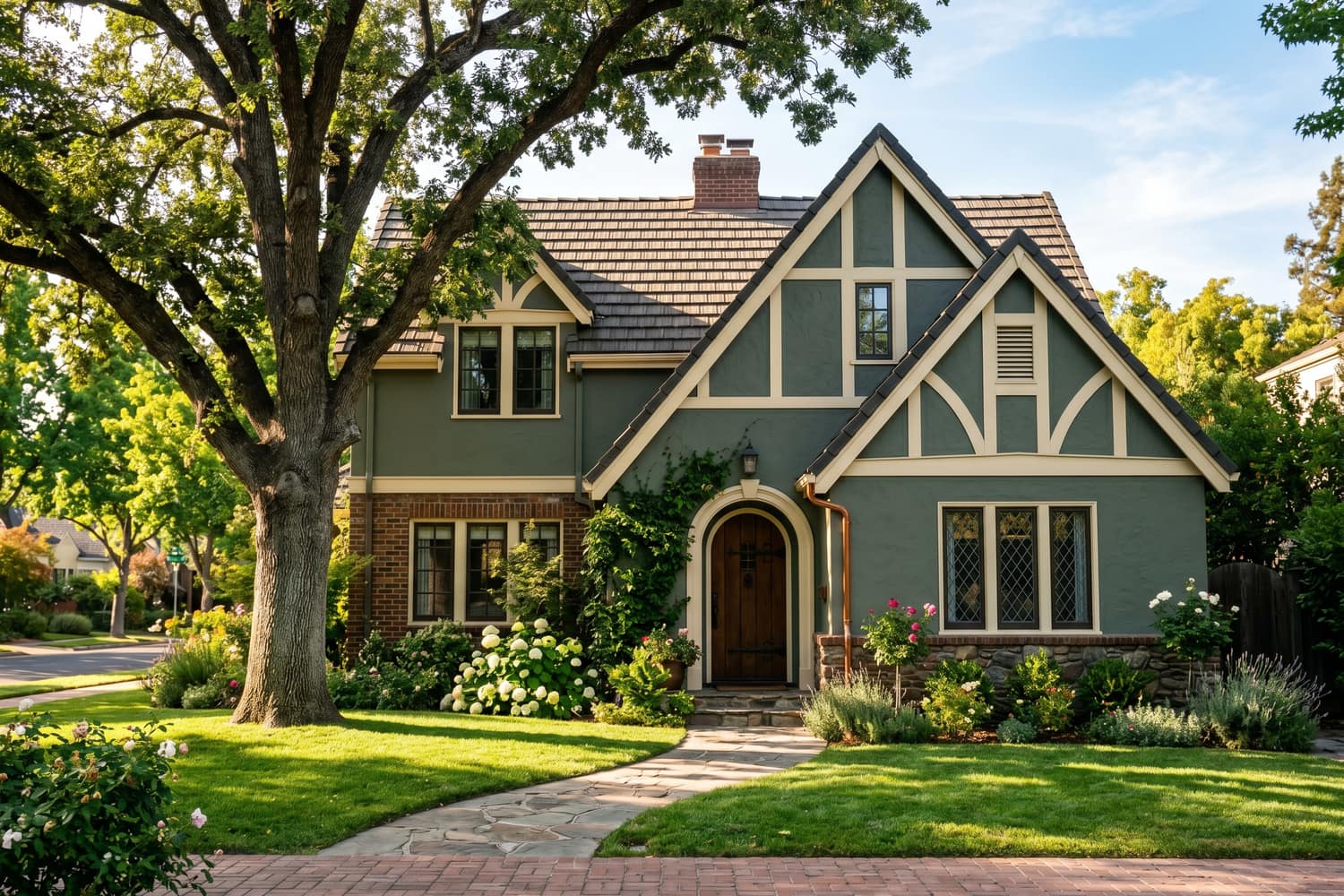
The Fabulous 40s — the roughly 12-block rectangle bounded by Folsom Boulevard, J Street, 40th Street, and 46th Street — is East Sacramento's highest-end historic neighborhood. The housing stock is a mix of Tudor Revival (steep gables, half-timbering, rounded or arched doors, stone or brick accents), Colonial Revival (symmetrical facades, multi-pane double-hung windows, classical columns or pediments), Mediterranean Revival (stucco, red tile roofs, arched windows), and Minimal Traditional.
Unlike Victorians and Craftsmans, Fab 40s homes were originally built in a more restrained color palette — muted historic neutrals with high-quality trim work.
- Tudor Revival wants dark half-timbering contrasted against pale stucco or light stone. Classic fields run in warm whites, pale cream, oatmeal, or soft gray stucco with near-black or dark brown timbering. Doors in bottle green, deep red, or natural stained oak.
- Colonial Revival wants symmetrical, classically inspired colors. White, off-white, soft yellow, pale blue-gray, or colonial Williamsburg-style greens with bright white trim, black shutters, and a strong accent door (black, red, or dark blue).
- Mediterranean Revival wants warm earthen stucco (cream, buttercream, blush, sand) with terra cotta accents, wrought iron details, and dark oak-stained or wrought-iron-trimmed doors.

The Fab 40s has an informal but meaningful color culture. The Fabulous 40s Neighborhood Association and longtime residents have a clear sense of which colors belong on which style of house, and going too far outside that range — a pure-white modern minimalist scheme on a 1937 Tudor, for example — gets noticed. It is not a legal restriction, but it is a resale and social reality.
How Much Does Exterior Painting Cost in East Sacramento in 2026?
East Sacramento exterior painting costs run higher than Sacramento averages for three reasons: the homes are larger and older, the prep work is deeper, and the historic multi-color schemes take more labor than a two-color production repaint. For a full Sacramento-wide breakdown, see our house painting cost guide; for East Sac specifically the numbers shift.
| East Sac Home Profile | Typical 2026 Cost Range |
|---|---|
| 1,200 sq ft Craftsman, 2-color scheme | $6,500 – $10,500 |
| 1,600 sq ft Craftsman, 3-color period scheme | $8,500 – $13,500 |
| 2,000 sq ft Victorian, 3- to 4-color Painted Lady | $11,000 – $17,500 |
| 2,400 sq ft Victorian, 4- to 5-color, heavy detail | $14,000 – $22,000 |
| 2,800 sq ft Fab 40s Tudor, stucco + timbering | $12,500 – $19,500 |
| 3,500 sq ft Fab 40s Colonial Revival | $15,000 – $24,000 |
| 4,200 sq ft Fab 40s custom, multiple elevations | $18,000 – $30,000+ |
Those ranges assume professional-grade paint (Sherwin-Williams Emerald or Duration, Benjamin Moore Aura, or Dunn-Edwards Evershield), two full coats, full pressure wash, scraping, sanding, priming, caulking, and cleanup. Cheaper bids exist; they typically cut paint grade, skip prep steps, or stretch spread rate beyond spec.

What Drives the Range
Four factors swing an East Sac repaint by 30–50% at the same square footage:
- Number of colors. A two-color repaint is straightforward. A four- or five-color Victorian scheme adds 25–40% in labor because every color transition requires its own cut line, its own masking, and its own brushwork.
- Prep intensity. Many East Sac homes have paint histories 80–130 years deep. Scraping off failed layers, spot-priming bare wood, replacing rotted trim, and dealing with lead-safe work practices on pre-1978 homes all add real cost. See our lead paint testing in Sacramento guide.
- Architectural detail. Spindles, brackets, dentils, shingle gables, and divided-light windows all slow production dramatically. A featureless stucco box paints two to three times faster per square foot than a Queen Anne.
- Access. Two-story Fab 40s homes with steep gables often require scaffolding rather than ladder work on certain elevations, adding equipment and labor.
Sacramento Sun and the Southern Wall Problem
Every East Sacramento home has a south-facing elevation that is going to take twice the UV punishment of the north side. Sacramento UV index hits 9–10 in June and July, and surface temperatures on dark-colored south walls can exceed 170°F in August (Weather Spark Sacramento, 2025). That heat and UV combination drives premature chalking, binder breakdown, and color fade — especially on dark Victorian greens, Craftsman browns, and Tudor near-blacks.
For a full breakdown of why and how to mitigate, see our guide on south-facing wall paint fading in Sacramento. For East Sacramento historic homes, the practical rules are:
- Keep LRV at or above 30 on south and west elevations, especially in deep Victorian or Craftsman earth tones. An olive green with LRV 12 will fade visibly in 4–6 years; the same green at LRV 32 holds for 8–10 years.
- Specify premium acrylic exterior paint — Sherwin-Williams Emerald with SunReflective or Duration, Benjamin Moore Aura or Regal Select, or Dunn-Edwards Evershield. Our breakdown of best exterior paint for Sacramento climate covers the specific products.
- Two full coats at spec spread rate — 350 to 400 sq ft per gallon. Stretching to 500+ sq ft per gallon cuts film thickness in half and slashes UV durability.
- Use IR-reflective colorants on dark accents. Sherwin-Williams and Benjamin Moore both offer cool-pigment tinting for dark colors. It adds a small cost and can double the effective life of a dark Craftsman door or a Tudor timber color on a south wall.
For more on color strategy that survives California sun, see the best exterior paint colors California guide.

Sacramento & Placer County
Need a real quote on your project?
Free, no-obligation walkthrough. Itemized estimate within 24 hours. Most jobs scheduled within 2–3 weeks.
HOA and Neighborhood Color Rules in the Fab 40s
A common question from buyers and homeowners is whether the Fab 40s has HOA color rules.
The short answer: there is no formal HOA color covenant in the Fabulous 40s. There is no governing board that approves or denies paint colors in writing, and there are no legal restrictions on your fan deck choice the way there are in a tract HOA in Roseville or Folsom. For a general overview of HOA paint rules in California, see our HOA painting guidelines.
The longer answer: the Fab 40s has stronger-than-HOA social color conventions. The Fabulous 40s Neighborhood Association, active real estate agents in the neighborhood, appraisers, and longtime residents all have clear expectations about what colors belong on what style of home. Homes that paint outside those conventions — too trendy, too modern, too high-contrast for the architecture — tend to take longer to sell and appraise lower than color-appropriate comparables.
Practical implications:
- Any color you can defend as period-appropriate for the style of home is safe.
- Modern trend colors like moody black, stark all-white, or high-saturation blues read as out of context on 1930s–1940s Tudors and Colonials.
- Stucco homes can be a wider color range than wood-sided homes but still want to stay in warm historic neutrals.
- When in doubt, walk the neighborhood and photograph three or four homes in your style that you consider well-painted. Those photos are your real color guide.
Some East Sacramento subdivisions built in the 1950s and later (e.g., parts of River Park and post-war infill) may have formal HOA documents. Check your CC&Rs before painting if your home is in a post-1950 pocket.
Prep Requirements for 80- to 130-Year-Old Homes
Up to 80% of premature exterior paint failures trace back to inadequate surface preparation, not the paint itself (Sherwin-Williams architectural specifier guide, 2024). On an East Sac historic home, prep is often 40–60% of the total labor budget. Shortcuts here are where a cheap bid fails.
Minimum exterior prep on a pre-1940 East Sac home:
- Full pressure wash at 2,500–3,000 PSI to strip chalk, dirt, cobwebs, mildew. See our power washing before painting guide for Sacramento-specific technique. Allow 24–48 hours of drying time in summer.
- Lead-safe scraping on pre-1978 homes. EPA RRP rules require lead-certified contractors for any disturbance of known or presumed lead paint. Our lead paint testing in Sacramento guide covers what is legally required and how to budget.
- Scrape, sand, and feather edges on every area of peeling or failing paint. A proper feather eliminates visible ridges under the new topcoat.
- Spot prime bare wood with a high-adhesion exterior primer. Oil-based primers still outperform latex on weathered bare redwood and Douglas fir common in East Sac. Existing tight paint that is sound does not need priming.
- Replace rotted trim before painting. Painting over soft wood is a cosmetic fix that fails within one or two winters. Common rot locations: porch column bases, window sills facing south/west, fascia corners where downspouts run.
- Caulk all joints with premium polyurethane or elastomeric caulk rated for thermal cycling. Sacramento's 80°F–100°F day/night swings in summer destroy budget acrylic caulk quickly.
- Mask windows, fixtures, and plants before any spraying. Overspray damage on a neighboring Fab 40s home is a real and expensive mistake.
For the full walkthrough of what to do before the crew arrives, see our what to do before painters arrive guide and the broader exterior painting preparation overview.
How Often Should an East Sac Home Be Repainted?
Most East Sac exteriors are on a 7- to 12-year full repaint cycle with spot maintenance in years 4–6 on the south and west elevations. Three factors move that window:
- Paint grade. Budget acrylics in Sacramento sun begin visible failure at year 4–5; premium acrylics hold to year 10+. See the how long exterior paint lasts breakdown.
- Color LRV. Deep Victorian greens at LRV 10–15 will need refresh on south walls by year 5–6. The same home in LRV 35+ colors stretches to year 10.
- Prep quality on the previous paint job. A house that was prepped properly 9 years ago repaints cleanly; a house that was not often needs major scraping and priming that adds $2,000–$5,000 to the next repaint.
For a detailed local schedule, see how often to repaint a house in Sacramento.
Frequently Asked Questions
What are the best exterior paint colors for East Sacramento?
The best exterior paint colors for East Sacramento depend on the architectural style of the home. Victorian homes look best in three- to five-color historic palettes with deep olive greens, sage, muted brick red, Prussian blue, or warm cream fields and contrasting trim. Craftsman bungalows want earthy field colors like warm olive, moss, taupe, or brown with warm cream trim and a saturated accent door. Fab 40s Tudors work in pale cream stucco with dark brown or black timbering; Colonial Revivals want white or soft neutral fields with bright trim and black or red accents; Mediterraneans wear warm sand, buttercream, or blush stucco. Across all styles, keep LRV at or above 30 on sun-exposed walls to survive Sacramento summer UV.
How much does exterior painting cost in East Sacramento?
Exterior painting in East Sacramento typically runs $7,500 to $22,000 for most homes, with smaller 1,200–1,600 sq ft Craftsman bungalows on the lower end and 2,400+ sq ft Victorians and 3,500+ sq ft Fab 40s homes pushing the higher end. Multi-color historic schemes (three to five colors) add 25–40% in labor versus simple two-color repaints. Heavy prep work on pre-1940 wood-sided homes adds another 15–25%. Expect the top of the range for Fab 40s homes over 4,000 sq ft and for fully restored Victorian "painted lady" schemes.
Are there HOA color rules in Fab 40s?
There is no formal HOA color covenant in the Fabulous 40s neighborhood of East Sacramento — no governing board approves paint colors in writing. There are, however, strong neighborhood conventions enforced informally by the Fabulous 40s Neighborhood Association, real estate agents, appraisers, and longtime residents. Homes painted outside period-appropriate historic palettes tend to take longer to sell and appraise lower. Any color defensible as historically appropriate for the home's architectural style — Tudor Revival, Colonial Revival, or Mediterranean — is socially and financially safe. Modern trend colors like matte black, stark white, or saturated jewel tones often read out of context on 1930s–1940s architecture.
How often do East Sac homes need repainting?
East Sacramento homes typically need a full exterior repaint every 7 to 12 years, with south- and west-facing walls often needing a maintenance coat at year 5–6. Premium acrylic paint (Sherwin-Williams Emerald, Benjamin Moore Aura, Dunn-Edwards Evershield) stretches the window to 10–12 years. Budget paint falls into visible chalking and fade by year 4–5 on sun-exposed elevations. Dark colors (LRV under 20) on south walls generally need refresh 2–3 years earlier than light colors (LRV 50+) on the same home.
Should I paint a historic home different colors than a modern home?
Yes — matching the paint color palette to the home's architectural period is one of the biggest factors separating a professional historic repaint from a generic one. A 1912 Craftsman painted modern gray-and-white loses its architectural character; a 1930s Tudor painted matte-black-and-white reads as a trendy remodel rather than preservation. Period-correct palettes — Victorian earth tones with three to five colors, Craftsman warm browns and olives with a saturated door, Fab 40s historic neutrals with period-appropriate accents — preserve architectural integrity, support resale value, and respect neighborhood character. Modern homes have far more color freedom; historic homes perform best within their period palette.
What paint holds up best on an East Sacramento exterior?
For East Sacramento historic homes, three exterior acrylic paints consistently outperform the rest in Central Valley sun: Sherwin-Williams Emerald Exterior (with SunReflective technology on dark colors), Benjamin Moore Aura Exterior (excellent dark-color retention), and Dunn-Edwards Evershield (formulated for Western U.S. UV and heat). All three deliver 8–12 years of service life when applied at manufacturer-spec spread rate in two full coats. For stucco Fab 40s homes, premium elastomeric coatings can bridge hairline stucco cracks and extend service life to 12–15 years on south elevations. Avoid budget contractor-grade exteriors — the cost savings disappear in a repaint cycle that is three to four years shorter.
Preserve the Architecture. Survive the Sun.
East Sacramento exteriors are historic first and modern second. The right repaint starts with the architectural period — Victorian, Craftsman, or Fab 40s Tudor, Colonial, or Mediterranean — and builds a palette that respects that period while engineering the paint film to survive Sacramento's Central Valley sun.
ProFlow Painting has repainted Victorians near McKinley Park, Craftsman bungalows on 37th and 38th Streets, and Fab 40s Tudors and Colonials across the neighborhood. We know which period colors work, which paints deliver their stated warranty in Sacramento heat, and how to handle lead-safe prep on pre-1978 homes.
Your free East Sacramento exterior assessment includes:
- Architectural style identification and period-appropriate color recommendations
- Historic multi-color scheme design (three- to five-color Victorian, Craftsman earth tones, Fab 40s neutrals)
- Sacramento sun and LRV analysis for south- and west-facing walls
- Lead-safe prep assessment on pre-1978 homes
- Transparent quote with paint spec, spread rate, film thickness, and warranty in writing
Call (916) 740-7249 to schedule your free East Sacramento exterior assessment. We serve East Sac, the Fabulous 40s, Midtown, McKinley Park, Curtis Park, Land Park, Elmhurst, River Park, and the surrounding Sacramento historic neighborhoods with professional exterior painting built around both architectural accuracy and Central Valley climate reality.
ProFlow Painting | East Sacramento Historic Home Exterior Painting | Sacramento, CA | (916) 740-7249
Free quote · Sacramento & Placer County
Ready for a real estimate, not a guess?
Tell us about your project and we'll walk it with you in person. Itemized quote within 24 hours, no high-pressure sales.