

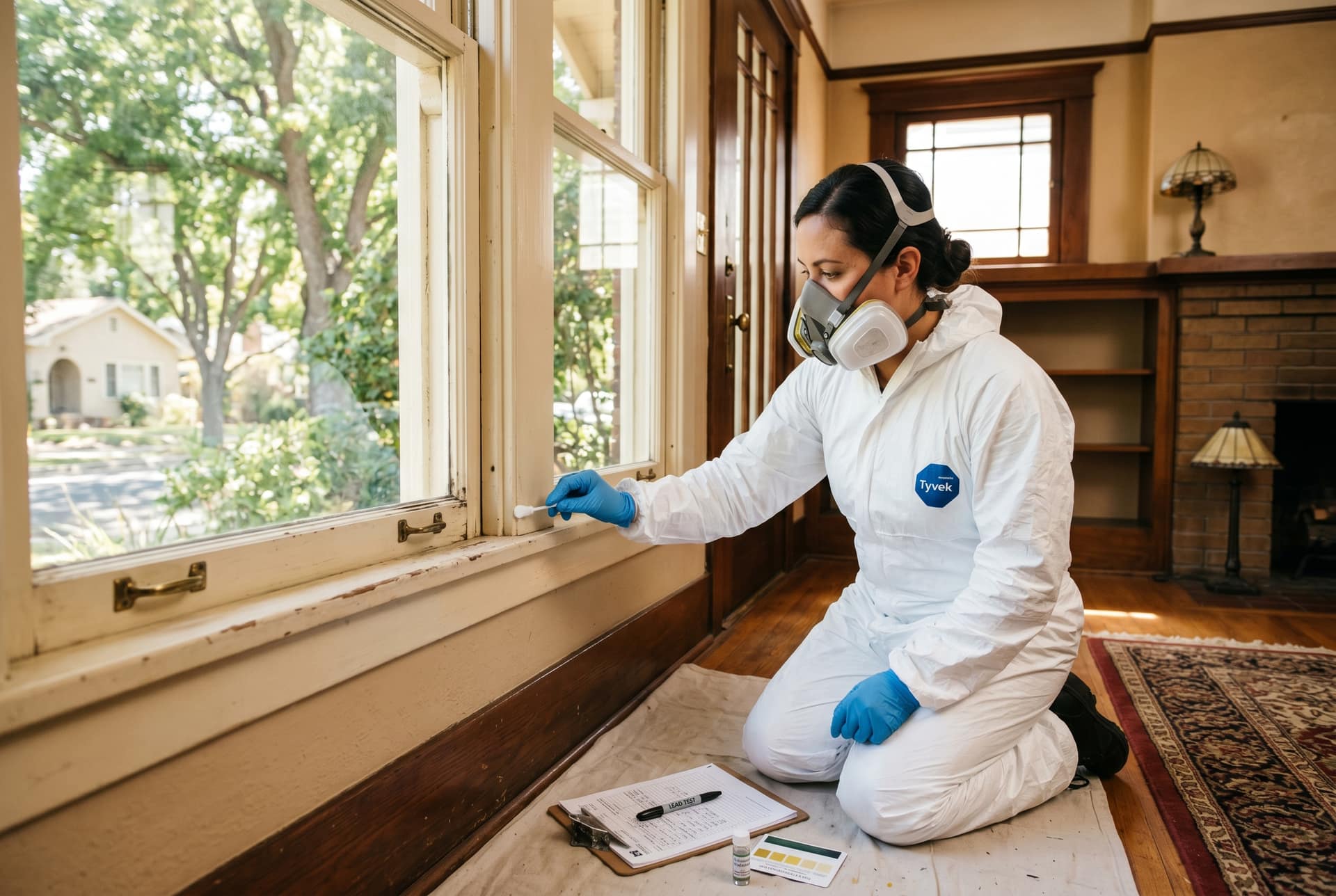
Lead paint testing in Sacramento starts with one number: 87% of homes built before 1940 contain lead-based paint (EPA, 2021). Sacramento is full of exactly that kind of housing stock — Land Park, Curtis Park, Oak Park, Midtown, and East Sacramento all have dense concentrations of pre-1978 homes. This isn't a historical footnote. About 500,000 U.S. children currently have blood lead levels at or above the CDC's reference value of 3.5 µg/dL (CDC, Aug 2025).
Before you repaint, renovate, or hire a contractor to prep your walls, you need to know whether lead paint is present. This guide covers how to find out, what testing costs, what California law requires, and what your options are once you have results.
If you're budgeting for a full repaint, start with our Sacramento house painting cost guide to understand total project costs.
Does Your Sacramento Home Have Lead Paint?
Lead-based paint was banned for residential use in 1978, but 34.6 million U.S. homes — about 29.4% of all housing — still contain it (EPA, 2021). The older the home, the higher the odds. If your Sacramento house predates 1978, lead paint is a real possibility, not a remote one.
The probability breaks down sharply by era:
| Home Age | Probability of Lead Paint |
|---|---|
| Built before 1940 | ~87% |
| Built 1940–1959 | ~69% |
| Built 1960–1978 | ~24% |
| Built after 1978 | 0% (banned) |
Source: EPA, 2021
Sacramento's older neighborhoods aren't outliers. They're the bull's-eye. Land Park, Curtis Park, East Sacramento, Midtown, and Oak Park all have housing stock built heavily in the 1940s and 1950s. Nearly 48% of owner-occupied U.S. homes were built before 1980, with a median housing age of 41 years (NAHB, 2025). In Sacramento's older grid neighborhoods, that share is even higher.
Lead paint that's intact and undisturbed isn't immediately dangerous. The hazard happens when paint starts peeling, chalking, or gets disturbed by sanding, scraping, or demolition. That's when lead dust becomes airborne — and that's when it becomes a health risk for adults and children alike.
So how do you actually know? Visual inspection alone won't tell you. Paint can look perfectly fine and still test positive for lead. The only way to know for certain is professional testing.
The EPA estimates 34.6 million U.S. homes (29.4%) contain lead-based paint. Probability by era: 87% for pre-1940 homes, ~69% for 1940–1959 homes, and 24% for 1960–1978 homes. After 1978, residential lead paint was banned entirely (EPA, 2021).
How Much Does Lead Paint Testing Cost?
Professional lead paint inspection in California runs $300–$700 on average, with a national average near $500 (HomeGuide, 2026). Your cost depends on the type of testing, the size of your home, and whether you want a full risk assessment. There's a meaningful range here, and the cheapest option isn't always the most useful one.
Here's how the main testing types compare:
| Testing Method | Cost | Best For | Destructive? |
|---|---|---|---|
| XRF (X-ray fluorescence) | $250–$700 | Whole-home, non-destructive | No |
| Swab/paint chip sampling | $100–$300 | Single room or surface | Minor — small sample |
| Full risk assessment | $500–$1,500 | Pre-renovation clearance | No |
| DIY swab kits | $10–$40 | Initial screening only | No |
Source: Angi, 2026; HomeGuide, 2026
XRF testing is the gold standard for whole-home evaluations. An XRF device reads lead content through paint layers without cutting or scraping anything. It's fast, thorough, and produces results you can actually rely on. Swab kits from the hardware store cost $10–$40 but they're notoriously unreliable — they can miss lead beneath top paint layers and produce false negatives that give you a false sense of security.
For context on what lead paint testing adds to your total painting budget, check our interior painting cost guide.
A full risk assessment at $500–$1,500 goes further than a standard inspection. It identifies lead hazards (not just lead presence), assesses condition, and produces a clearance report. If you're doing any renovation work in a pre-1978 home, contractors may require this documentation before they start.
For most Sacramento homeowners planning a repaint, an XRF inspection in the $300–$500 range covers what you need. If your home is large or you're planning significant renovation, budget for a full risk assessment.
Professional lead paint testing in Sacramento costs $300–$700 for standard inspection, with XRF testing running $250–$700 and full risk assessments reaching $500–$1,500. DIY swab kits cost just $10–$40 but are unreliable due to false negatives (Angi, 2026; HomeGuide, 2026).
Who Can Legally Test for Lead Paint in California?
In California, only CDPH-certified Lead Inspectors or Risk Assessors can legally conduct lead paint testing (CDPH). This surprises a lot of homeowners — and more than a few contractors. Your painting contractor, no matter how experienced, is not permitted to test for lead under California law. Testing requires separate certification.
This is a California-specific rule that goes beyond federal EPA requirements. Nationally, EPA certification governs renovation and remediation work. California adds its own layer through the Department of Public Health's Childhood Lead Poisoning Prevention Branch (CLPPB), which certifies inspectors, risk assessors, and project monitors independently.
How to Find a Certified Inspector in Sacramento
Start at the CDPH's online certification lookup tool. Search for "Lead Inspector/Risk Assessor" and filter by Sacramento County. You can also ask for referrals from your painting contractor — reputable lead-safe painters work with certified inspectors regularly and can connect you.
Inspection vs. Risk Assessment: What's the Difference?
A lead inspection tells you whether lead-based paint is present. A risk assessment tells you whether it's a hazard in its current condition. Risk assessments are more thorough and produce the documentation needed before renovation work begins. If you're just repainting intact walls, an inspection may be enough. If you're replacing windows, opening walls, or scraping, you want a risk assessment.
California law requires CDPH-certified Lead Inspectors or Risk Assessors to conduct lead paint testing. Painting contractors are not permitted to test. California's certification system is administered separately from EPA certification through the CDPH Childhood Lead Poisoning Prevention Branch (CDPH).
What Happens If Your Contractor Disturbs Lead Paint?
The EPA's Renovation, Repair, and Painting (RRP) Rule requires that any work disturbing more than 6 square feet of interior surface or more than 20 square feet of exterior surface in a pre-1978 home must be performed by an EPA Certified Renovator (EPA). This applies to painting contractors, remodelers, and anyone doing prep work that breaks the paint surface.
RRP Thresholds at a Glance
| Location | Threshold Requiring RRP Compliance |
|---|---|
| Interior surfaces | >6 sq ft disturbed |
| Exterior surfaces | >20 sq ft disturbed |
| Windows (any age) | Any disturbance |
| Pre-1978 child-occupied facilities | Any disturbance |
Source: EPA RRP Rule
The fines are not small. Violations can reach $37,500 per day per violation under EPA enforcement. California's additional state-level penalties make non-compliance even more expensive. An unlicensed contractor who disturbs lead paint without proper procedures puts you and your family at risk — and can expose you to liability if you knowingly hired them.
How to Verify Your Painter's EPA Certification
Ask directly. Request the contractor's EPA Certified Firm number, which you can verify at the EPA's certified firm lookup tool. Certified firms are required to follow RRP work practice standards: containment, HEPA vacuuming, no dry scraping or sanding, and proper waste disposal.
If a contractor waves off your lead paint questions or says they "don't need certification for a simple repaint," that's a red flag. Any prep work on a pre-1978 exterior easily hits 20 square feet. That's two or three window frames. Our exterior painting preparation guide covers what proper prep work looks like.
The EPA's RRP Rule requires EPA Certified Renovators for any work disturbing more than 6 sq ft of interior surface or 20 sq ft of exterior surface in pre-1978 homes. Violations carry fines up to $37,500 per day per violation (EPA).
Sacramento & Placer County
Need a real quote on your project?
Free, no-obligation walkthrough. Itemized estimate within 24 hours. Most jobs scheduled within 2–3 weeks.
Should You Encapsulate or Remove Lead Paint?
Encapsulation costs $1–$4 per square foot and can last 10–20 years when done correctly (HomeAdvisor, 2025). Full abatement runs $6–$17 per square foot, with average total project costs of $1,478–$5,520 (Angi, 2025). These aren't interchangeable options. The right choice depends on the paint's condition, the surfaces involved, and your long-term plans for the home.
Encapsulation vs. Abatement: Side-by-Side
| Factor | Encapsulation | Full Abatement |
|---|---|---|
| Cost per sq ft | $1–$4 | $6–$17 |
| Average project cost | $500–$2,500 | $1,478–$5,520 |
| Permanence | 10–20 years (requires monitoring) | Permanent |
| Lead removed from home? | No — sealed in place | Yes |
| Works on friction surfaces? | No | Yes |
| Disruption level | Low | High |
| Best for | Intact paint, stable surfaces | Deteriorating paint, friction surfaces, selling soon |
Sources: HomeAdvisor, 2025; Angi, 2025
Encapsulation means applying a bonding agent or thick encapsulant coating over existing lead paint to seal it permanently. It's not just painting over it — standard latex paint doesn't qualify. You need a product specifically rated as a lead encapsulant. It works well on walls, ceilings, and stable surfaces that won't be disturbed.
Abatement is the complete removal of lead paint, either by wet scraping, chemical stripping, or HEPA vacuuming. It's permanent and eliminates the hazard entirely. It also costs 4–5x more than encapsulation and requires relocating your family during the work period. For a deep dive on surface prep methods, see our interior painting preparation guide.
When Abatement Makes More Sense
Abatement is worth the higher cost in specific situations: when paint is severely deteriorating, when friction surfaces like windows and doors are involved (encapsulants don't hold up under repeated contact), or when you're planning to sell and want a clean disclosure. Friction surfaces are a critical factor — encapsulation fails on surfaces that rub against each other because the coating wears through.
Lead paint encapsulation costs $1–$4 per square foot and lasts 10–20 years. Full abatement costs $6–$17 per square foot with average project costs of $1,478–$5,520. Encapsulation doesn't work on friction surfaces like windows and doors, where abatement is the appropriate solution (HomeAdvisor, 2025; Angi, 2025).
Can You Paint Over Lead Paint Safely?
Yes — with conditions. If the existing lead paint is intact, firmly adhered, and on a non-friction surface, painting over it using a certified lead encapsulant is an acceptable approach under EPA guidelines (EPA). You're not eliminating the lead, but you're sealing it so it can't chip, dust, or off-gas.
The key word is "intact." Peeling, chalking, flaking, or blistering paint is not a candidate for painting over. Neither are surfaces subject to friction or impact — windows, door frames, stair railings, floor surfaces. Those surfaces need abatement, not encapsulation.
Regular latex or oil-based paints don't qualify as encapsulants. Products must meet ASTM E1795 standards for lead encapsulation. Ask your contractor or inspector to specify the correct product for your surface type. To understand how long different paint types hold up, read our guide on how long exterior paint lasts.
In our experience working on pre-1978 homes throughout Sacramento, the biggest mistake homeowners make is assuming that lead paint is only a concern if they can see it chipping. Paint in seemingly good condition — especially on original window trim — frequently tests positive. XRF testing has caught lead on surfaces that looked freshly painted because multiple layers had been applied over the original coat.
When Painting Over Is NOT Safe
Don't paint over lead in these situations:
- Paint is peeling, chalking, bubbling, or cracking
- Surface is a friction point (windows, doors, floor)
- Surface will be sanded or scraped during prep
- You're in a rental property subject to California's lead disclosure requirements
Painting over intact lead paint with a certified lead encapsulant meeting ASTM E1795 standards is acceptable under EPA guidelines. However, peeling or deteriorating paint and friction surfaces require abatement, not encapsulation. Standard latex and oil-based paints do not qualify as encapsulants (EPA).
How to Hire a Lead-Safe Painting Contractor in Sacramento
Hiring the wrong contractor for a pre-1978 home isn't just a quality risk — it's a health and legal risk. The EPA estimates that 860,000 children per year have elevated blood lead levels from exposure during home renovation work (EPA). Vetting your contractor takes ten minutes and is worth every one of them.
Four Things to Verify Before Signing a Contract
1. EPA Certified Firm status. Look up any contractor at the EPA Certified Firm lookup. This is free, takes two minutes, and tells you immediately whether the firm is certified to work on pre-1978 homes.
2. RRP compliance plan. Ask before the project starts what containment procedures they use, how they handle lead waste, and whether they HEPA vacuum after prep work. A contractor who can't answer these questions hasn't done this before.
3. Get lead testing done first. Don't rely on the contractor to assess whether lead testing is needed. Have a CDPH-certified inspector test before any work begins. It protects you, and it gives the contractor accurate information for scoping the job.
4. Written documentation. Request the post-project clearance report if abatement was performed. Keep it with your home records. California's lead disclosure requirements for real estate transactions mean you'll want this paperwork when you sell. For a full cost breakdown, see our interior painting cost guide.
Most Sacramento homeowners focus on price when vetting painters. But for pre-1978 homes, EPA certification status is the more important filter. A non-certified contractor who gives you a low bid on a pre-1940 home in Oak Park or Land Park is passing hidden costs onto you — in the form of health risk, potential liability, and the possibility of a failed clearance test that delays your project by weeks.
Lead Paint Testing FAQ for Sacramento Homeowners
How do I know if my house has lead paint?
The only reliable way is professional testing. Visual inspection isn't enough — lead paint can look perfectly fine under multiple layers of newer paint. If your home was built before 1978, assume lead paint may be present and get an XRF inspection from a CDPH-certified inspector. XRF testing runs $250–$700 (Angi, 2026) and produces results the same day.
Is lead paint dangerous if painted over?
Intact lead paint that's painted over with a certified encapsulant (not standard latex) is not an immediate hazard. The danger comes when paint deteriorates, chips, or gets disturbed during renovation. About 500,000 U.S. children have blood lead levels at or above the CDC reference value of 3.5 µg/dL (CDC, Aug 2025), largely from dust and chips created during home disturbance work.
How much does lead paint testing cost in California?
Expect to pay $300–$700 for professional XRF inspection in California, with full risk assessments running $500–$1,500 (HomeGuide, 2026). DIY swab kits are available for $10–$40 but are unreliable and don't satisfy California's requirement for certified inspector testing before renovation work. Testing done before a project almost always costs less than remediation after a lead exposure incident.
What year did they stop using lead paint?
The U.S. banned lead-based paint for residential use in 1978. Before that, lead was a common additive that improved durability and adhesion. Homes built before 1978 may contain it; homes built after 1978 do not. The older the home, the higher the odds — 87% of pre-1940 homes contain lead paint compared to 24% of homes built between 1960 and 1978 (EPA, 2021).
Do I need a certified inspector to test for lead paint in California?
Yes. California law requires CDPH-certified Lead Inspectors or Risk Assessors to conduct lead paint testing (CDPH). Your painting contractor cannot legally perform this testing, regardless of their experience. Find certified inspectors through the CDPH certification lookup. This is a California-specific requirement that goes beyond federal EPA standards. See our exterior painting preparation guide for more on working with pre-1978 surfaces.
What Sacramento Homeowners Should Do Before Repainting
Lead paint in Sacramento homes is a real, manageable issue — not a reason to panic, and not something to ignore. If your home predates 1978, lead paint testing before any painting or renovation project is the right call. It protects your family, protects your contractor, and keeps your project from hitting expensive compliance problems mid-stream.
Here's what to take away. Get CDPH-certified testing done before any work begins. Hire only EPA Certified Firms for pre-1978 renovation projects. Know the difference between encapsulation and abatement — the right choice depends on your paint's condition and the surfaces involved. And don't rely on visual inspection alone.
In Sacramento's older grid neighborhoods, we've found that homes in the 1940s–1960s construction band almost always warrant professional testing before exterior prep work. In our last 40+ pre-1978 exterior repaints, 34 required certified testing before prep work could begin. The 20 square foot RRP threshold gets crossed faster than most homeowners realize.
Call ProFlow Painting at (916) 740-7249 for lead-safe painting services in Sacramento. We're an EPA Certified Firm and work with CDPH-certified inspectors to make sure your project is handled correctly from the first brush stroke. See our full Sacramento painting cost guide for complete pricing details.
Free quote · Sacramento & Placer County
Ready for a real estimate, not a guess?
Tell us about your project and we'll walk it with you in person. Itemized quote within 24 hours, no high-pressure sales.