
Yes, you should fix stucco cracks before painting your Sacramento home — every time, no exceptions. Painting over unrepaired cracks traps moisture, voids most paint warranties, and the cracks reappear through the new coating within 12 to 24 months. The repair cost is small compared to the recoat cost when it fails.
Sacramento's clay soil expansion, 100°F-plus summers, and foothill freeze-thaw cycles work cracks open faster than coastal climates. A hairline crack in a Land Park bungalow today is a 1/8-inch gap by next August. Fixing it correctly before paint is the single highest-use prep step on a stucco repaint.
This guide covers the four crack types Sacramento painters see most, exact repair products and dry times, when to call a structural pro, and how the prep work folds into a full repaint. If you're still pricing the project, our stucco painting cost guide for Sacramento covers full pricing in detail.
Should You Fix Stucco Cracks Before Painting? (Short Answer: Yes)
Cracks are the single biggest source of paint failure on Sacramento stucco. Standard acrylic paint forms a film 1.5–3 mils thick — about the thickness of a sheet of paper. That film cannot bridge a crack any wider than a strand of human hair. Even elastomeric coatings, which stretch 300–800%, are rated to bridge hairline cracks only up to 1/16 inch (Behr, 2026).
Painting over a crack does three things, all bad:
- Telegraphs the defect. The crack outline shows through the new finish within weeks, especially in raking sunlight on west-facing walls.
- Voids the manufacturer warranty. Sherwin-Williams, Benjamin Moore, and Dunn-Edwards all require crack repair as a condition of warranty coverage.
- Funnels water behind the stucco. Sacramento's December–February rain finds the open crack, sits behind the paint film, and rots wood lath or lifts the new coating off in sheets.
The math heavily favors repair. A typical hairline crack repair costs $5–$15 in materials and 10 minutes of labor. A failed repaint on a 1,800 sq ft Sacramento home costs $4,500–$9,000 to redo (HomeGuide, 2026). Fixing the crack is the cheap insurance.
Sacramento's climate makes the case stronger than most regions. Clay-heavy soils across Curtis Park, Tahoe Park, and the Pocket-Greenhaven flats expand and contract dramatically between rainy and dry seasons. That foundation movement transmits directly into the stucco above, opening hairline cracks every summer. Foothill homes in El Dorado Hills and Folsom add winter freeze-thaw to the mix on a few nights per year, which widens any existing crack by another 5–10%.
Citation capsule: Standard acrylic exterior paint forms a film 1.5–3 mils thick and cannot bridge cracks wider than 1/64 inch. Elastomeric coatings bridge cracks up to 1/16 inch but require pre-repaired substrate for cracks beyond that (Behr, 2026; Sherwin-Williams, 2025). Painting over unrepaired cracks voids most manufacturer warranties.
Hairline vs Structural Stucco Cracks: How to Tell the Difference
Not every stucco crack is a problem. Most are harmless thermal cracks that need basic patching. A small percentage signal foundation or framing movement that needs a structural inspection before any paint touches the wall. Telling them apart is the most important diagnostic step in the entire prep process.
The four crack types Sacramento painters see most often:
| Crack Type | Width | Pattern | Cause | Action Required |
|---|---|---|---|---|
| Hairline / map cracking | Under 1/16" | Random, web-like | Thermal expansion, normal aging | DIY caulk + paint |
| Diagonal at corners | 1/16"–1/4" | 45° off window/door corners | Settling, moderate | Patch + monitor |
| Stair-step | Any width | Follows mortar joints or block lines | Foundation movement | Structural inspection |
| Vertical / wide | Over 1/4" | Long, single-line, may be deep | Major movement, framing failure | Structural inspection |
Hairline Cracks (The Easy Ones)
Hairline cracks are thinner than a credit card edge — under 1/16 inch wide. They appear as random web-like patterns across large stucco panels, especially on south- and west-facing walls that take the worst Sacramento sun. These are pure thermal cracks, caused by the stucco expanding in summer heat and contracting in winter. They have nothing to do with structural problems.
Hairline cracks are the most common type on every Sacramento stucco home over 10 years old. Land Park bungalows and Curtis Park craftsmans built in the 1920s–1940s typically show them across the upper sections. Elk Grove and Natomas tract homes built in the 1990s–2000s show them on south-facing walls first. Both are normal and both are DIY-friendly.
Diagonal Cracks at Window and Door Corners
Diagonal cracks running 45 degrees off the upper corners of windows and doors usually indicate moderate settling. These are common in homes 15–40 years old and are not automatically a structural emergency, but they warrant attention. If the crack is under 1/4 inch wide and stable (not growing month over month), patching is fine. If it's growing or wider than 1/4 inch, get an inspection.
Stair-Step Cracks (Call a Pro)
Stair-step cracks follow mortar joints in a stair-pattern across the wall. On stucco-over-block construction, they trace the block lines. These almost always indicate foundation movement and should never be cosmetically patched without a structural assessment first. Cosmetic repair just hides an active problem until it gets expensive.
Wide or Vertical Cracks (Call a Pro)
Any crack wider than 1/4 inch, or a long vertical crack running floor-to-ceiling height, signals significant movement. Common causes include foundation settling, framing failure, or in older Sacramento homes, missing or rotted wood lath behind the stucco. These need a structural engineer's look before paint.
For homes already showing peeling or bubbling paint near cracks, our guide on how to fix peeling paint covers the underlying repair process before recoating.
How to Patch Hairline Stucco Cracks Before Painting (Step-by-Step)
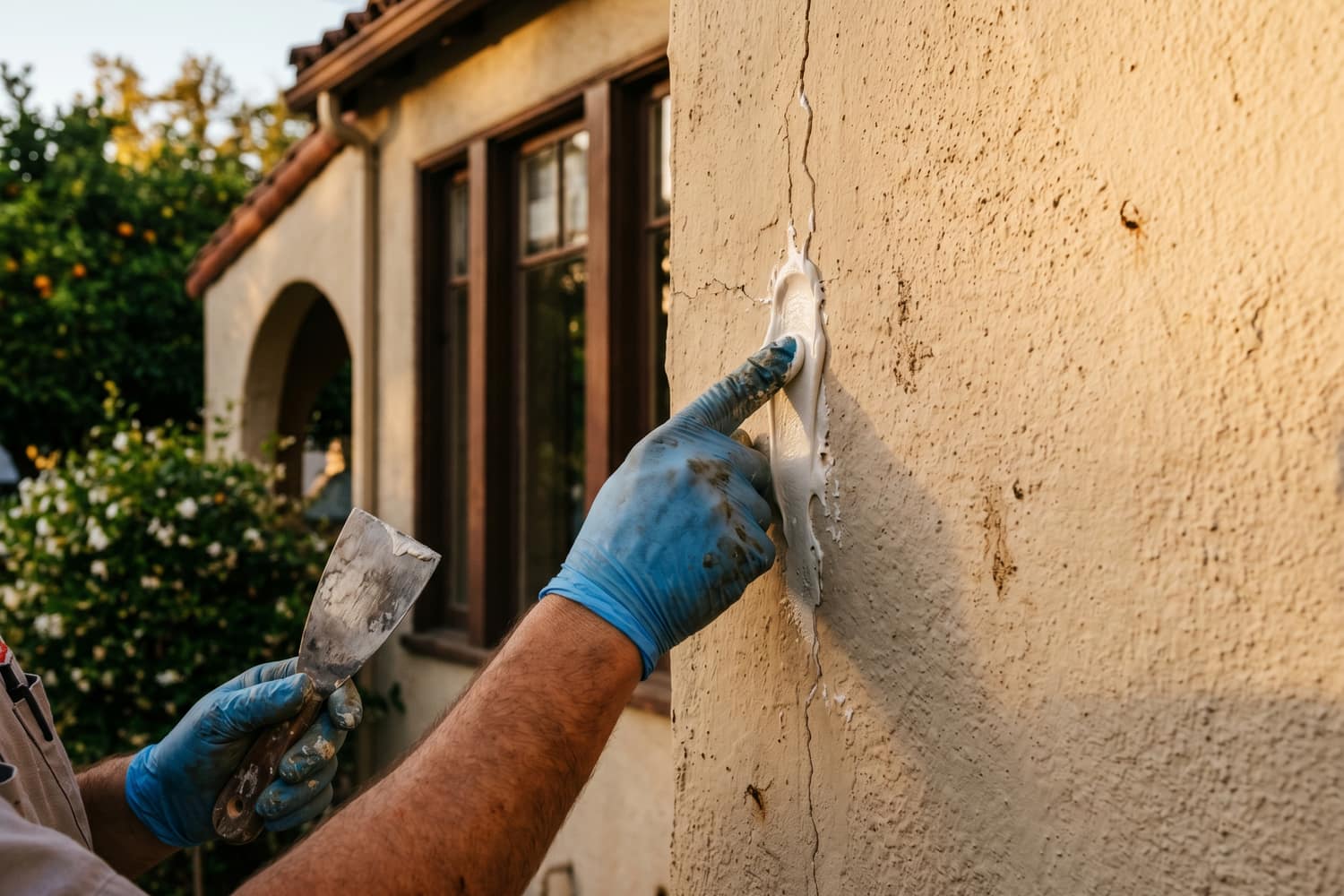
Hairline crack repair on Sacramento stucco is one of the most rewarding DIY paint-prep tasks. With $20 in materials and an afternoon, you can prep a typical 1,800 sq ft home for paint and add 5+ years to the coating's lifespan.
What You'll Need
- Elastomeric caulk (Quad Max, OSI Quad, or Sherwin-Williams Loxon)
- Caulk gun
- Stiff wire brush
- Putty knife or 5-in-1 tool
- Damp rag and bucket of water
- Painters' tape (optional)
- Texture matching spray for visible repairs (Homax Roll-On Stucco Patch or similar)
Step 1: Clean the Crack
Use the wire brush to scrub loose stucco, dirt, and chalky residue out of the crack. Brush along the crack length, then across it. Wipe with a damp rag and let dry for at least an hour. Sacramento's dry climate works in your favor here — most days the surface is fully dry within 30–60 minutes.
Step 2: Widen Hairline Cracks Slightly
This step feels counterintuitive but it matters. Run the corner of a 5-in-1 tool or a stiff putty knife down the crack to slightly widen and deepen it — about 1/8 inch wide and 1/8 inch deep. This gives the caulk something to grip. A perfectly tight hairline crack is too narrow to hold caulk, and the bead pops out within a year.
Step 3: Apply Elastomeric Caulk
Cut the caulk tube tip at a 45-degree angle to match the crack width (about 1/8 inch opening). Run a continuous bead down the crack, pressing the gun tip into the crack so caulk fills the depth. Move at a steady pace — about 1 foot every 5 seconds — to avoid blobs and gaps.
Step 4: Tool the Bead
Drag a damp finger down the bead to push caulk into the crack and feather the edges flush with the stucco surface. On textured stucco, dab the wet caulk with a damp rag or sponge to break up the smooth caulk surface and roughly match the surrounding texture. Skipping this step makes the repair visible through paint as a smooth glossy line.
Step 5: Match the Texture (For Visible Areas)
For repairs on prominent walls — the front of the house, areas at eye level — apply a thin coat of texture matching product over the dried caulk. Roll-on stucco patch products work well; spray products give more authentic results but require more skill. Test on a hidden spot first.
Step 6: Cure Before Painting
This is the step DIYers blow most often. Elastomeric caulk needs at least 24 hours of cure time before paint goes over it. Painting too early traps solvents in the caulk, causing bubbling and adhesion failure within a few months. Sacramento's dry summer air helps caulk cure faster, but 24 hours is the minimum across all conditions.
For cracks 1/16–1/4 inch wide, the process changes. Skip the caulk and use a stucco patching compound (Quikrete Stucco Repair, DAP Premium Stucco Patch, or Rapid Set Stucco Patch). These need 7 days to fully cure before paint per manufacturer specifications.
| Crack Size | Repair Product | Cure Time Before Paint | Cost (DIY) |
|---|---|---|---|
| Under 1/16" | Elastomeric caulk | 24 hours | $5–$10 per crack |
| 1/16"–1/4" | Stucco patching compound | 7 days | $15–$40 per repair |
| 1/4"–1/2" | Stucco patching compound + mesh | 7 days | $25–$75 per repair |
| Over 1/2" | Pro repair after structural review | Varies | $300–$1,500+ |
If you're tackling a full exterior prep project, our exterior painting preparation guide covers the surrounding steps — pressure washing, scraping, priming — that turn crack repair into a complete prep workflow.
Stucco Patching Cost in Sacramento: DIY vs Pro
Stucco crack repair costs in Sacramento vary widely based on crack count, size, and whether you DIY or hire out. The cost spread is one of the largest in any prep category — a homeowner who patches their own hairline cracks spends $20 in materials, while the same job through a contractor runs $400–$800.
DIY Cost Range
A Sacramento homeowner repairing hairline cracks across an 1,800 sq ft single-story home typically spends:
- 2 tubes elastomeric caulk: $14–$20
- Wire brush + putty knife: $10–$15 (one-time tool buy)
- Texture matching product: $15–$25 (optional, for visible repairs)
- Total DIY hairline repair: $40–$60
For a home with 5–10 medium cracks (1/16–1/4 inch) needing patching compound:
- 2 tubs stucco patch: $30–$50
- Mesh tape (if needed): $8–$15
- Total DIY medium repair: $40–$65
Professional Cost Range
Hiring a Sacramento painting contractor or stucco specialist for crack repair as part of a full repaint typically adds:
- Hairline crack repair (full house): $200–$500 added to paint quote
- Medium crack patching (5–10 cracks): $400–$900
- Major patching (1/4"+ cracks, mesh required): $800–$2,500
- Structural assessment (when needed): $300–$1,500 for engineer's report
Most reputable Sacramento painters bundle hairline crack repair into the prep line of the estimate rather than charging separately. If your quote breaks out crack repair as a $500+ line item with no medium or wider cracks present, that's worth questioning.
When DIY Makes Sense
DIY crack repair is reasonable when you have hairline cracks only, a single-story home (no ladder height issues), and the patience to do clean work. Cracks at 12 feet up on a two-story home almost always go to a pro — the time and ladder safety risk isn't worth $200 in saved labor. Our two-story house painting cost guide covers that height premium in more detail.
DIY stops being a good idea when:
- You have stair-step or wide vertical cracks (structural risk)
- Cracks are above the first-story roofline (ladder safety)
- The total crack count is over 50–75 (labor time eats the savings)
- Texture matching matters and you've never done it before (visible repairs are worse than no repairs)
Citation capsule: Sacramento DIY hairline stucco crack repair costs $40–$60 in materials for an 1,800 sq ft home, while professional repair adds $200–$500 to a paint quote. Structural cracks requiring engineer assessment add $300–$1,500 before any cosmetic work begins (Quikrete, 2025; HomeGuide, 2026).
Can Elastomeric Paint Cover Stucco Cracks Without Repair?
Elastomeric paint is marketed heavily for crack-bridging, but the practical answer is more nuanced than the marketing suggests. Elastomeric coatings can bridge hairline cracks up to 1/16 inch wide without separate patching, when applied at proper film thickness (Behr, 2026). For anything wider, the coating will telegraph the crack within months, and on cracks 1/8 inch and wider, it will tear or split along the crack line within the first year of thermal cycling.
The realistic scope of what elastomeric covers without prep:
- Random web-pattern hairline cracks under 1/64 inch: Yes, the coating bridges these reliably
- Hairline cracks 1/64"–1/16": Yes, with proper 10–15 mil film thickness
- Cracks 1/16"–1/8": Patching required first; elastomeric will tear otherwise
- Cracks over 1/8": Patching required, often with mesh reinforcement
- Stair-step or structural cracks: Never paint over without engineering review
The most common Sacramento mistake is assuming elastomeric is a magic fix that lets you skip prep. It isn't. Even at the high end of crack-bridging capacity, elastomeric requires a clean, dry, properly-prepared substrate to perform. Spraying $4,500–$9,000 of elastomeric over unprepared cracked stucco produces the same failure pattern as standard acrylic — just at 2x the cost.
For a deeper look at when elastomeric is and isn't worth the premium, our elastomeric paint for stucco guide covers the full decision framework, including the moisture-trapping risk on older homes.
Sacramento & Placer County
Need a real quote on your project?
Free, no-obligation walkthrough. Itemized estimate within 24 hours. Most jobs scheduled within 2–3 weeks.
Sacramento Climate Considerations: Why Cracks Form Faster Here
Sacramento Valley climate accelerates stucco cracking compared to most California regions. Three local factors drive the faster crack formation rate, and understanding them helps you time repairs correctly.
Clay Soil Expansion
The Sacramento basin sits on heavy clay soils that swell dramatically when wet and shrink when dry. Between November and March, clay absorbs winter rain and pushes upward against foundations. Between June and October, it dries and pulls away, often opening 1–2 inches of gap along foundation edges in extreme drought years.
That seasonal soil movement transmits straight into stucco walls above. Neighborhoods with the most expansive clay — Land Park, Curtis Park, East Sacramento, Tahoe Park, and the Pocket-Greenhaven flats — show the worst hairline cracking on homes 30+ years old. Newer tract construction in Elk Grove, Natomas, and Roseville often sits on engineered fill that performs better but isn't immune.
Hot-Dry Summer Cycles
Sacramento averages 70+ days per year above 90°F, and surface temperatures on south- and west-facing stucco walls regularly exceed 130°F in July and August (Weather Spark, 2026). That thermal load expands stucco daily through the summer, then contracts it overnight as temperatures drop into the 60s. Over a single summer, a south-facing wall sees roughly 90 expansion-contraction cycles. After 10 years, that's nearly 1,000 cycles working any weak point in the stucco into a visible crack.
For more on how Sacramento heat specifically damages exterior surfaces, see our guide on how Sacramento heat damages exterior paint. The same forces that fade pigment also propagate cracks.
Foothill Freeze-Thaw
Homes in the Sierra foothill suburbs — Folsom, El Dorado Hills, Cameron Park, Auburn — get a different cracking pattern. Winter overnight temperatures drop below freezing on 15–25 nights per year, and any moisture inside an existing hairline crack expands when it freezes, prying the crack open by another fraction. Spring thaws then leave the crack wider than it was in fall.
This means a crack you ignored last August in Folsom is roughly 10–20% wider this spring, even with no foundation movement. The fix-now-not-later case is strongest in foothill markets.
Neighborhood Patterns
| Neighborhood | Common Home Era | Typical Crack Pattern | Priority |
|---|---|---|---|
| Land Park | 1920s–1940s bungalows | Map cracking on upper walls, settlement at corners | High — older homes need close inspection |
| Curtis Park | 1910s–1940s craftsmans | Vertical cracks at additions, stair-step at older block | Inspection often warranted |
| East Sacramento | 1920s–1950s mix | Window-corner diagonals, hairline thermal | Medium |
| Pocket-Greenhaven | 1970s–1990s tract | Hairline thermal on south walls, slab settlement | Low — DIY-friendly |
| Elk Grove | 1990s–2010s tract stucco | South-wall thermal cracking | Low — DIY-friendly |
| Folsom / El Dorado Hills | 2000s–2020s newer | South-wall thermal + foothill freeze-thaw | Low–Medium |
For homeowners in Land Park specifically, our exterior house painting guide for Land Park covers the architectural and prep details for Tudor, Spanish Revival, and Mid-Century stucco homes in that area.
How Long Should Stucco Patch Cure Before Paint?
Cure time is the most-skipped step in stucco crack repair, and the cause of more first-year paint failures than any other single mistake. Different repair products have different cure requirements, and the manufacturer specs are not optional — they're the baseline below which the repair will fail.
| Repair Material | Minimum Cure Before Paint | Sacramento Reality |
|---|---|---|
| Elastomeric caulk | 24 hours | 24–48 hours summer; 48–72 hours winter |
| Acrylic latex caulk | 24 hours | 48 hours minimum recommended |
| Stucco patching compound (Quikrete) | 7 days | 7 days summer; 10–14 days winter |
| Rapid-set stucco patch | 24–48 hours | Per spec, but verify hardness before paint |
| Three-coat new stucco | 28 days | 28 days minimum, 60 days preferred |
| Lime-based traditional stucco | 60–90 days | 60+ days, with pH test before paint |
Why Cure Time Matters
Wet patching compound has a high pH (alkali) and contains free moisture. Painting over uncured patch causes two failure modes:
- Alkali burn: The high pH in fresh stucco patch chemically attacks paint binders, causing color shifts (especially on tinted paints) and adhesion loss.
- Moisture entrapment: Water vapor escaping the curing patch pushes paint film off the surface, creating bubbles that pop and leave bare spots.
Sacramento's dry summer climate helps but doesn't eliminate the issue. A 7-day cure on stucco patch in July is genuinely 7 days. Same cure in January, with overnight humidity above 80% and temperatures in the 40s–50s, can stretch to 10–14 days before the patch is paint-ready.
How to Verify Cure
Three field tests painters use before paint:
- Touch test: The patch should be hard, dry, and slightly cool to the touch (cooler than surrounding stucco indicates residual moisture)
- Color test: Cured stucco patch is uniformly light gray; darker spots indicate trapped moisture
- pH test: For new stucco or large patches, use a pH pencil or test strip — paint when pH is 8 or below (Sherwin-Williams, 2025)
For more on how to time exterior paint projects against Sacramento weather, see our guide on when to paint your house exterior.
When to Call a Structural Professional
Most Sacramento stucco cracks are cosmetic. A small percentage signal serious issues that no amount of caulk will fix. Knowing when to escalate from DIY repair to a structural engineer's review can save tens of thousands of dollars in undiagnosed foundation or framing failure.
Call a structural engineer or licensed general contractor for:
- Stair-step cracks of any width (foundation movement signal)
- Cracks wider than 1/4 inch anywhere on the house
- Cracks that have grown month-over-month (active movement)
- Multiple parallel diagonal cracks at the same window or door (frame failure)
- Cracks accompanied by interior drywall cracks in the same wall (whole-wall movement)
- Cracks at additions or remodel seams that are growing (improper tie-in)
- Vertical cracks running floor-to-roof (major movement)
- Any crack you can fit a credit card edge into and have it slide more than 1/4 inch deep (substrate failure behind the stucco)
A Sacramento structural engineer typically charges $400–$900 for a focused stucco crack inspection with a written report. That report is invaluable when getting paint quotes, because it documents what's been ruled in or out. It also protects you from contractor upsells claiming structural problems where none exist.
For older Sacramento homes — anything pre-1960 in Land Park, East Sacramento, Curtis Park, and the Fab 40s — a quick structural look-over is worth the money even on cosmetic-looking cracks. These homes often have wood lath behind the stucco that may be rotting from old plumbing leaks or original installation gaps. Modern contractors patching those walls without checking the lath are setting up the next failure cycle.
If you're working with an HOA, document everything before repair work begins — most HOAs require approval for repair work that affects the visible exterior, and some require licensed contractor receipts for warranty claims later. Our HOA painting guidelines post covers the approval process in detail.
How Crack Repair Fits Into a Full Stucco Repaint Sequence
Crack repair is one step in a 7-step prep sequence on a Sacramento stucco repaint. Doing it out of order — before pressure washing, for example — usually means redoing the work.
The professional Sacramento prep sequence:
- Initial inspection. Walk the house, mark every crack with chalk or pencil, photograph and date the worst ones, and decide DIY vs pro on each.
- Pressure washing. Wash at 1,500–2,000 PSI on stucco (lower than wood siding pressure to avoid pitting). Sacramento's dry summer means 24-hour dry time is usually enough; winter washing needs 48–72 hours. See our power washing before painting guide for full pressure-wash specs.
- Crack repair. Patch cracks per the size guide above. Cure time per product spec.
- Efflorescence removal. White mineral deposits get treated with vinegar wash or commercial efflorescence remover. Common on north-facing walls and in foothill homes.
- Priming. Bare stucco patches and any exposed substrate get a masonry primer compatible with the topcoat brand. Mixing brands is a common warranty-voiding mistake.
- Caulking around openings. Window frames, door frames, hose bibs, electrical penetrations all get fresh paintable caulk. Different from crack caulk — this is exterior siding caulk for the seam between stucco and dissimilar materials.
- Paint application. Two coats minimum. Spray-and-back-roll for elastomeric; spray-only or roller for standard acrylic.
Total Sacramento timeline: 2–4 days of active labor spread across 7–14 calendar days, depending on cure times. Most professional Sacramento repaints in good weather complete the full sequence in 5–7 days.
A practical example: A Pocket-Greenhaven homeowner with a 2,000 sq ft single-story stucco home in moderate condition. Inspection finds 40 hairline cracks, 6 medium cracks at window corners, and no structural concerns. Sequence runs:
- Day 1 (Saturday): Pressure wash, mark cracks
- Day 2 (Sunday): 48-hour dry begins
- Day 3–4 (Mon–Tue): Hairline crack caulking with 24-hour cure
- Day 5–11 (Wed–Tue): Medium crack patching with 7-day cure
- Day 12 (Wednesday): Prime patches, final caulking around openings
- Day 13–14 (Thursday–Friday): Two coats paint
Doing all of that without skipping cure days is the difference between a 5-year coating and a 12-year coating.
If you're choosing a contractor to handle this sequence rather than DIYing it, our 12-point checklist for choosing a Sacramento painting contractor covers what to verify before signing.
Frequently Asked Questions
Should I fix stucco cracks before painting?
Yes, always. Painting over unrepaired stucco cracks voids manufacturer paint warranties, telegraphs the crack pattern through the new coating within months, and lets winter rain into the wall cavity. Crack repair costs $40–$60 DIY or $200–$500 added to a professional paint quote — small relative to the $4,500–$9,000 cost of a failed repaint. Even minor hairline cracks reappear through unrepaired paint within 12–24 months on Sacramento homes.
What's the difference between hairline and structural stucco cracks?
Hairline cracks are thinner than 1/16 inch, appear in random web-like patterns from thermal expansion, and are cosmetic only. Structural cracks include stair-step patterns following block or mortar lines, cracks wider than 1/4 inch, and long vertical cracks — all signaling foundation or framing movement. Stair-step and wide cracks always need a structural engineer's assessment ($400–$900) before any cosmetic repair. A simple test: mark the crack ends with pencil and check 30 days later. Active growth means structural review.
Can elastomeric paint cover stucco cracks without repair?
Only hairline cracks under 1/16 inch wide (Behr, 2026). Cracks 1/16–1/8 inch will telegraph through within months and tear along the crack line within a year of thermal cycling. Cracks over 1/8 inch always require patching first. Spraying expensive elastomeric coating over unprepared cracked stucco produces the same failure pattern as cheap acrylic — just at higher cost.
How much does stucco crack repair cost in Sacramento?
DIY hairline crack repair runs $40–$60 in materials for an 1,800 sq ft Sacramento home (caulk, brushes, texture spray). Professional crack repair adds $200–$500 to a paint quote for hairline work, $400–$900 for medium cracks needing patching compound, and $800–$2,500 for major patching with mesh reinforcement. Structural cracks requiring engineering review add $400–$900 for the inspection alone, before any repair work starts.
How long should stucco patch cure before paint?
Elastomeric caulk needs at least 24 hours before paint. Stucco patching compound (Quikrete, DAP, Rapid Set) needs 7 days minimum per manufacturer specs (Quikrete, 2025). New three-coat stucco needs a full 28-day cure, ideally 60 days. Sacramento summer cure times are reliable; winter cure times stretch 50–100% longer due to cooler temps and overnight humidity. Painting over uncured patch causes alkali burn (color shifts) and bubbling from trapped moisture.
Do I need to patch every hairline crack on my stucco?
Yes, for any crack you can see at arm's length. Cracks invisible from 6 feet away can be left for the next paint cycle. Random thermal hairline cracking is normal on Sacramento stucco over 10 years old, and the goal is to repair every visible crack rather than just the worst ones. Skipping the small ones means they propagate through the new paint and you're back to the same problem 18 months later.
Can I paint stucco myself after repairing cracks?
For single-story Sacramento homes with hairline cracks only, DIY is reasonable if you have time and patience. For two-story homes, structural cracks, or large medium-crack counts, hire a pro — the labor savings rarely cover the safety risk and quality difference. Our DIY vs professional painting guide for Sacramento covers the cost and quality breakeven in detail.
The Bottom Line: Crack Repair Is the Highest-use Prep Step
Every dollar spent on proper stucco crack repair returns 5–10 dollars in extended coating lifespan on a Sacramento home. The math is overwhelming and the technique is teachable. If you're DIY-inclined, hairline crack repair on a single-story stucco home is one of the highest-ROI weekend projects in homeownership.
Three things to remember before starting:
- Diagnose first. Walk every wall, mark every crack, decide DIY vs pro on each. Most are DIY-friendly. The few that aren't will save you a lot of money by being identified before paint goes on.
- Respect cure times. Elastomeric caulk needs 24 hours, stucco patching compound needs 7 days, new stucco needs 28 days. Sacramento's dry summer helps but does not shorten manufacturer specs.
- Don't skip the small ones. Every visible hairline crack patched today is one less crack reappearing through next year's paint. The goal is full coverage, not greatest-hits coverage.
Need a professional eye on your stucco before paint? ProFlow Painting provides free Sacramento stucco assessments — we'll walk the house, mark every crack, distinguish cosmetic from structural, recommend the right repair products and cure schedule, and deliver a transparent itemized quote that breaks out prep, primer, and paint separately. Call (916) 740-7249 or request your free estimate online.
Free quote · Sacramento & Placer County
Ready for a real estimate, not a guess?
Tell us about your project and we'll walk it with you in person. Itemized quote within 24 hours, no high-pressure sales.