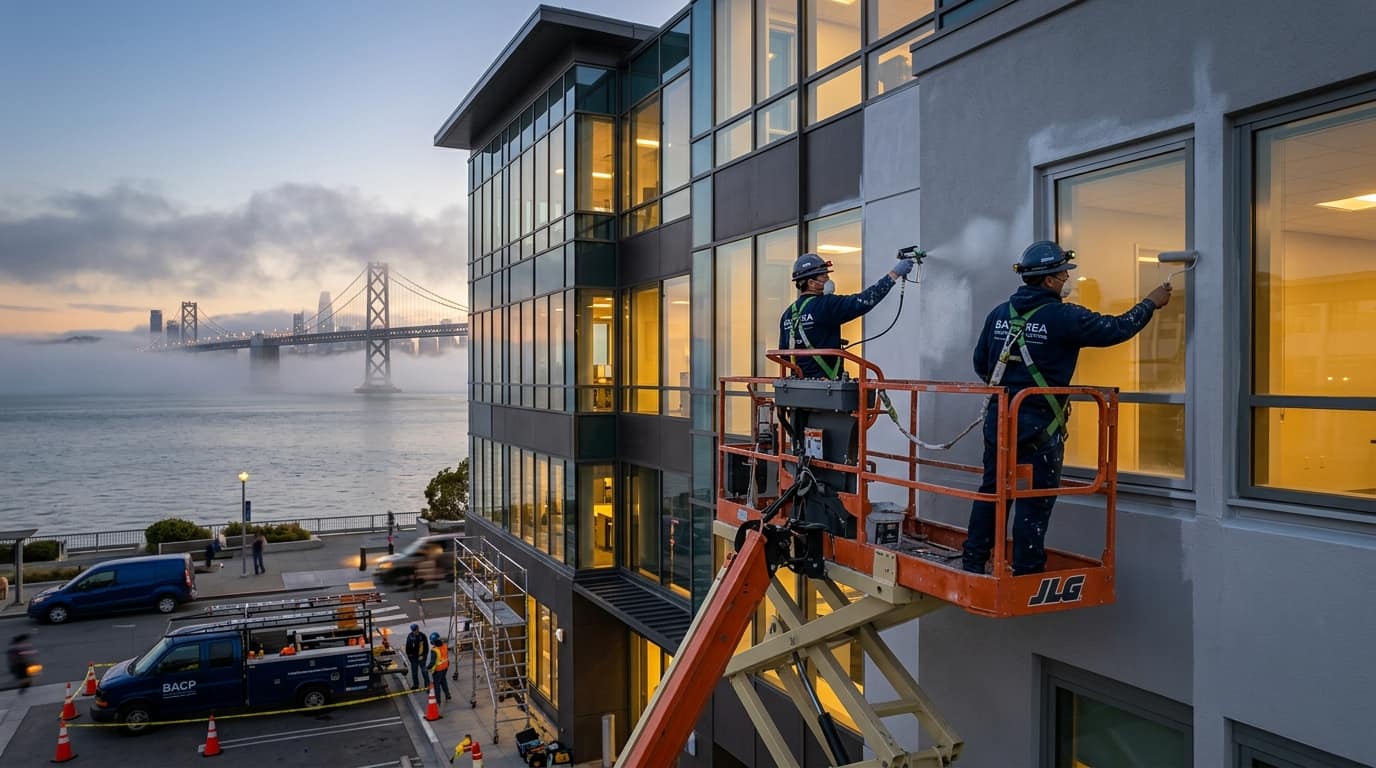

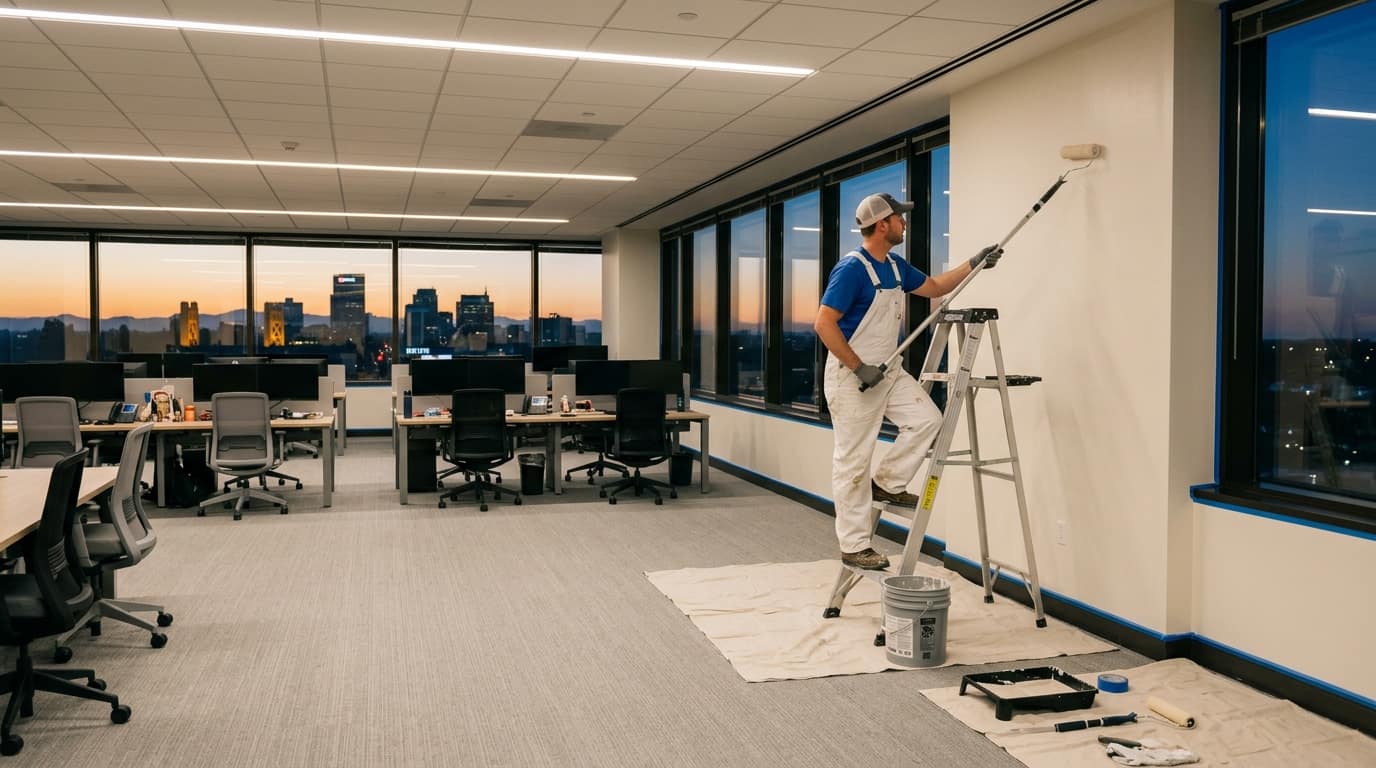
Office painting in Sacramento typically runs $1.85 to $4.50 per square foot for an interior repaint, with the final cost driven by square footage, ceiling height, the mix of open versus private offices, whether the work runs during business hours or after-hours, and the product grade required by the building's Class A, B, or C designation. Most downtown and Roseville Class A buildings require low-VOC paint, after-hours scheduling, and landlord-approved color palettes — which can add 20 to 40 percent to a base bid that ignores those requirements.
That is the short answer. The longer answer involves how tenant improvement (TI) allowances actually get negotiated in a Sacramento lease, why the SCAQMD and CARB VOC rules force product choices most painters do not understand, what the typical landlord paint rule looks like in a downtown Sacramento commercial lease, and how phased after-hours scheduling protects both the tenant's productivity and the landlord's CO and certificate of insurance requirements.
This guide breaks down 2026 Sacramento office painting prices for spaces from 1,000 to 25,000 square feet, the TI allowance language to negotiate before signing, after-hours pricing premiums, low-VOC and Class A finish requirements, ADA and Title 24 color contrast rules, and the landlord coordination steps that keep the project on schedule.
Why Office Painting Is a Different Beast Than Residential Work
A 2,500 square foot office is not a 2,500 square foot house. The substrate is mostly textured drywall over metal studs, ceiling heights run 9 to 12 feet, and the building owner usually has more say in the project than the tenant signing the check. The four things that make office painting fundamentally different:
- Landlord controls the rulebook. The lease, not the tenant, decides products, schedules, and colors.
- After-hours scheduling is the default. Most Class A and B buildings prohibit daytime painting in occupied space.
- Low-VOC requirements are stricter than residential. Occupied office air quality drives product selection beyond California rules.
- Tenant improvement allowances change the math. A $25,000 paint project may cost the tenant $5,000 out of pocket if TI is negotiated correctly.
ProFlow has walked into Sacramento offices where the tenant paid $14,000 cash for a daytime repaint that should have been a $9,000 after-hours job billed against TI — because nobody read the work letter.
Sacramento Office Painting Cost in 2026: Real Pricing Ranges
Sacramento office painting prices vary by square footage, scheduling, product grade, and building class. Here are realistic 2026 ranges for the metro:
| Office Size | Square Footage | Standard Daytime | After-Hours Phased | Class A / Low-VOC |
|---|---|---|---|---|
| Small suite | 800-1,500 sq ft | $1,800-$5,500 | $3,000-$8,500 | $4,000-$11,000 |
| Standard office | 2,000-3,500 sq ft | $4,500-$12,500 | $7,500-$18,500 | $10,500-$24,000 |
| Mid-size floor | 4,000-6,500 sq ft | $9,000-$22,000 | $14,500-$32,000 | $20,000-$42,000 |
| Large floorplate | 7,500-10,000 sq ft | $16,500-$36,000 | $26,000-$52,000 | $36,000-$72,000 |
| Multi-floor | 12,000-25,000 sq ft | $28,000-$92,000 | $45,000-$135,000 | $62,000-$185,000 |
Sacramento commercial painting averages $1.45 per square foot for low-spec daytime interior work (Homeyou, 2026), but most office projects sit materially higher because the building's rules force after-hours scheduling, low-VOC products, and additional protection. Budget $2.50 to $4.50 per square foot as a realistic Sacramento starting point for code-compliant office painting in a Class B building, $4.50 to $8.00 for Class A space with full low-VOC specifications and union labor.
For a broader view across building types — retail, warehouse, medical, and mixed-use — see our commercial painting cost guide which covers per-square-foot rates and the factors that drive them.
What Drives Office Painting Costs Up in Sacramento
- After-hours and weekend premiums add 25 to 50 percent over daytime labor rates.
- Low-VOC and zero-VOC products like Sherwin-Williams Harmony or Benjamin Moore Natura cost 20 to 35 percent more per gallon.
- Ceiling height above 10 feet triggers a 10 to 25 percent surcharge for staging or lift rental.
- Glass partition and cubicle protection. Open-plan offices have hundreds of linear feet of glass, electrical, and tech needing masking and de-mask labor.
- Workstation moves when the painter disassembles and resets cubicles instead of facilities team handling it.
- Custom color matching runs $25 to $75 per gallon over standard fan deck pricing.
- Certificate of insurance escalation. Landlords often require $2M to $5M coverage with the building owner and property manager named additional insured.
- HVAC and life safety coordination. Air handler shutdowns, smoke detector covers, and elevator lockouts.
- Freight elevator scheduling. Class A buildings restrict freight access to specific windows and charge for after-hours building services.
What Brings Office Painting Costs Down
A few moves typically save Sacramento office tenants 10 to 30 percent on a repaint:
- Painting during a lease commencement or move-out gap when the space is empty
- Phasing across multiple weekends with smaller crews to avoid overtime stacking
- Selecting two or three accent colors against a single base color rather than a custom-mixed palette
- Skipping ceilings if they are still in good condition (most Class A drop ceilings only need spot work)
- Bundling repaint with carpet, flooring, or millwork TI work to share protection and freight costs
- Reusing existing color codes if the property manager has them on file
- Combining the project with related eco-friendly painting work to qualify for product volume discounts
Tenant Improvement Allowance: What Actually Counts as Paint
Tenant improvement (TI) allowance is the dollar amount per rentable square foot the landlord agrees to spend on the tenant's space. In Sacramento, TI for office leases typically runs $4 to $15 per rentable square foot for renewals and refreshes, $20 to $60 for new tenant build-outs. Paint is almost always TI-eligible, but the lease language controls what counts.
The categories TI typically covers for paint work:
| Category | TI-Eligible? | Notes |
|---|---|---|
| Wall paint and prep labor | Usually yes | Standard line item |
| Ceiling paint | Sometimes | Depends on tiles vs drywall |
| Trim, doors, casework | Usually yes | If part of original build-out |
| Custom corporate colors | Usually yes | Color match fees billable to TI |
| Cubicle disassembly/reset | Sometimes | Often considered tenant FFE |
| After-hours premiums | Usually yes | Building-rule-driven |
| Insurance and bonds | Usually yes | If required by the lease |
| Wallpaper removal / demo | Usually yes | Standard prep |
| Furniture moves and storage | Sometimes | Depends on the work letter |
A Sacramento Class B office lease might offer $8 per rentable square foot in TI for a 5-year renewal on a 5,000 square foot suite — $40,000 total. A code-compliant interior repaint with after-hours scheduling and low-VOC products runs $24,000 to $36,000 of that, leaving $4,000 to $16,000 for carpet patching or other refresh items.
For how multi-unit boards handle similar allowance negotiations, see our HOA painting guidelines.
SCAQMD, CARB and Why Sacramento Offices Need Low-VOC Paint
California Air Resources Board (CARB) Suggested Control Measure for Architectural Coatings caps the VOC content in interior paints sold and applied in California, and the Sacramento Metropolitan Air Quality Management District enforces these limits locally. For occupied office space, the practical interpretation goes well beyond what the legal limits require.
Current VOC limits under the state-adopted framework:
| Product Category | VOC Limit (g/L) | Typical Office Use |
|---|---|---|
| Flat coatings | 50 | Ceilings, low-traffic walls |
| Non-flat coatings | 100 | Open work areas, private offices |
| High gloss | 150 | Trim, doors, lobby millwork |
| Waterborne primers | 100 | Drywall repair zones |
| Anti-graffiti | 600 | Stairwell and back-of-house only |
Citation capsule: California Air Resources Board adopted the 2019 Suggested Control Measure for Architectural Coatings setting the 50 g/L VOC limit for interior flat coatings, enforced in the Sacramento metro by SMAQMD (California Air Resources Board, 2024).
Class A office buildings in Sacramento have largely standardized on zero-VOC product lines because of LEED, WELL Building Standard, and indoor air quality requirements that go beyond CARB minimums. The three products that show up on most Class A specifications: Sherwin-Williams Harmony (zero VOC, GREENGUARD Gold, formaldehyde-reducing), Benjamin Moore Natura (zero VOC, asthma and allergy friendly), and PPG Pure Performance (zero VOC, scrub-resistant for high-traffic corridors).
The difference matters more in an occupied office than people realize. Most office HVAC systems recirculate 70 to 80 percent of the building's air rather than pulling in fresh outside air, so VOCs from daytime paint application can build up in occupied zones for days. Zero-VOC products keep the project compliant with both the law and the property manager's air quality clauses. For more on low-emitting options, see our eco-friendly painting Sacramento guide.
After-Hours Scheduling: Why It Costs More and How to Phase It
Most Sacramento Class A and B office buildings explicitly prohibit daytime painting in occupied space. The lease typically requires work after 6:00 PM on weeknights, before 7:00 AM on weekday mornings, or anytime on weekends. This is a building rule driven by air quality (paint odor in shared HVAC), fire and life safety (egress paths), noise and disruption to adjacent tenants, slip-risk liability, and building services coordination — and it drives a 25 to 50 percent labor premium.
The standard Sacramento after-hours premium structure:
| Schedule | Typical Premium | Best Use |
|---|---|---|
| Weeknight evenings (6-10 PM) | 15-25% | Small suites, single-room work |
| Weeknight overnight (10 PM - 6 AM) | 30-50% | Larger phased projects |
| Saturday daytime | 20-35% | Bulk work, full suite repaints |
| Sunday daytime | 25-40% | Continuous full-day work |
| Holiday weekends | 40-75% | Major projects with no weekday option |
A typical 5,000 sq ft Sacramento office repaint takes 2 to 3 weekends plus 2 to 4 weekday evenings to complete with zero employee disruption. Total elapsed calendar time runs 10 to 14 days from kickoff to punch list signoff.
Landlord Paint Rules: What Almost Every Sacramento Lease Requires
The landlord paint rule pattern in Sacramento commercial leases is remarkably consistent. Here is what almost every Class A and Class B office lease requires:
- Pre-approval of colors. Landlord must approve the color palette in writing before painting begins, with samples submitted from a manufacturer-standard fan deck.
- Pre-approval of product specifications. Submittal package including manufacturer data sheets, VOC compliance certificates, GREENGUARD or similar certifications, and product warranties.
- Licensed and bonded contractor only. California C-33 painting contractor's license required, often with minimum 5 years of commercial experience.
- Certificate of insurance. Typically $1M general liability minimum, $2M to $5M for Class A buildings, with landlord and property manager named as additional insured.
- Workers compensation coverage. California-compliant policy with the landlord receiving a certificate.
- After-hours work only. No daytime painting in occupied space, defined hours specified in the lease.
- Building services check-in. Painter checks in with security and building engineering before each work session.
- Freight elevator and loading dock reservations. Required for material delivery and equipment staging.
- Cleanup and protection standards. Floors, furniture, electronics, glass, and shared corridors protected and cleaned daily.
- Punch list signoff with property manager. Final walkthrough required for project closeout and TI billing.
Some Sacramento Class A buildings — particularly downtown high-rises like U.S. Bank Tower, Renaissance Tower, and Wells Fargo Center — also require building-approved vendor lists, 48-hour advance notice for wet paint near corridors, life-safety-approved smoke detector covers, air quality monitoring during application, and post-paint indoor air quality readings before reoccupancy.
For tenants in Sacramento commercial buildings, the practical advice: request the building's vendor rules document from the property manager before bidding. It tells the painter exactly what they need to comply with — saving 1 to 3 weeks of back-and-forth on submittals.
Class A vs Class B vs Class C: How Building Designation Drives Spec
A Class A office is a recently constructed or renovated property with premium finishes and the highest rents. Class B is a stable mid-tier building. Class C is older with deferred maintenance and looser tenant rules. The painting spec varies dramatically by class.
| Class | Typical Spec | Sacramento Examples | Cost Range |
|---|---|---|---|
| Class A | Zero-VOC, GREENGUARD Gold, after-hours, building-approved vendor | U.S. Bank Tower, Renaissance Tower, 500 Capitol Mall | $4.50-$8.00/sq ft |
| Class B | Low-VOC, after-hours preferred, certificate of insurance | Office parks in Roseville, Folsom, Natomas | $2.50-$4.50/sq ft |
| Class C | Standard products, daytime work often permitted | Older suburban office, light industrial flex | $1.85-$3.25/sq ft |
The Class A premium covers product upgrades, after-hours labor, building services coordination, and documentation overhead. A Class A repaint for a 3,000 square foot suite might cost $18,000 against the same scope at $9,500 in a Class C building. Tenants who try to deliver Class C work in a Class A building get rejected on the punch walk and pay twice.
For how warehouse and industrial spaces compare on cost and product spec, see our warehouse painting Sacramento guide.
Sacramento & Placer County
Need a real quote on your project?
Free, no-obligation walkthrough. Itemized estimate within 24 hours. Most jobs scheduled within 2–3 weeks.
Cure Times and Reoccupancy: 24 to 48 Hours
Modern waterborne acrylics are touch-dry within 1 to 2 hours and recoat-ready in 4 hours, but full cure — the point at which the film reaches rated hardness and scrub resistance — takes 14 to 30 days depending on temperature and humidity.
For office reoccupancy, the practical milestones are: light service at 24 hours (workstations reset, occupants return), full service at 72 hours (wall hooks, art, monitors reinstalled), and full cure at 14 to 30 days (maximum scrub resistance achieved). Sacramento's HVAC-controlled office temperatures of 68 to 74°F and 30 to 50 percent indoor humidity support reliable cure times within these windows.
ADA, Title 24 and Color Contrast Requirements
Most Sacramento offices are not required to follow exact ADA color contrast standards on interior paint, but specific zones absolutely are: the path of travel from the entry to the elevator lobby, signage backgrounds, restroom interior walls, exit pathways, and any wayfinding wall designation. California Title 24 reinforces these requirements through the California Building Code accessibility provisions.
The Title 24 and ADA color contrast points that affect office paint:
- Wayfinding signage backgrounds must contrast with surrounding wall color by at least 70 percent (Title 24 Section 11B-703.5.1)
- Emergency egress signage areas require non-glare wall finish behind the sign
- Restroom walls in publicly accessible offices must support clear signage contrast
- Stair handrails and edges require color demarcation if painted as part of the project
- Door frames in egress paths require sufficient contrast against the wall for visual identification
In practice, this rarely changes the paint color choices in the open work area or private offices, but it does drive specific color decisions at the elevator lobby, restroom corridors, stairwells, and any signage zone. ProFlow flags these areas at the scoping stage and proposes a contrast-compliant color palette before submitting to the landlord for approval.
Sacramento Office Submarkets: Pricing by Location
Each Sacramento office submarket has its own pricing patterns, landlord rules, and scheduling complexity:
- Downtown Sacramento / Capitol corridor. High-rise Class A, strict rules, after-hours required, premium specs. Expect the top of cost ranges — typically 15 to 25 percent more than suburban projects.
- Midtown. Mix of historic conversion buildings and newer mid-rise. Older plaster walls require more prep. Pricing varies widely by building age.
- Natomas and Northgate. Class B office parks with the most reasonable pricing in the metro. After-hours premiums apply but rules are looser than downtown.
- Roseville, Folsom, El Dorado Hills. Newer Class A and B office parks with sophisticated property management. ProFlow handles high volume through Roseville commercial painting and Folsom commercial painting.
- Rancho Cordova and Mather. Tech and government tenants, longer leases with substantial TI budgets, mix of Class A, B, and converted industrial space.
- Elk Grove and South Sacramento. Newer suburban office, lower density, simpler projects — see our Elk Grove commercial painting page for local patterns.
Sacramento County has approximately 75 million square feet of office inventory with vacancy rates in the 15 to 22 percent range over recent years (CBRE Sacramento Office MarketView, 2024), creating tenant-favorable lease negotiations and more aggressive TI allowances for paint and refresh work.
Office Painting Repaint Frequency: How Often to Repaint
Office paint wears differently than residential paint — foot traffic, HVAC supply vent staining, chair and desk contact, and cleaning protocols all matter. A realistic Sacramento schedule by zone:
| Zone | Repaint Frequency | Why |
|---|---|---|
| High-traffic corridors | Every 3-4 years | Shoulder rubs, cart impact, scuffs |
| Open work areas | Every 4-6 years | Workstation contact, chair backs |
| Private offices | Every 5-7 years | Lower contact, slower wear |
| Conference rooms | Every 4-5 years | Chair rail wear, high visibility |
| Reception and lobby | Every 3-5 years | First impressions, branding refreshes |
| Restrooms | Every 3-4 years | Constant cleaning, moisture, sanitizer |
| Break rooms | Every 4-5 years | Food and beverage cleanup |
| Building exterior | Every 5-8 years | Sun exposure, signage refreshes |
For public-facing or branding-sensitive industries (legal, finance, tech, professional services), shorter cycles apply. For full benchmarks across building types, see our commercial painting maintenance schedule.
Lead Paint Testing for Pre-1978 Office Buildings
Any Sacramento office building constructed before 1978 may contain lead paint. The EPA Renovation, Repair, and Painting Rule (RRP) requires certified lead-safe work practices on any project disturbing more than six square feet of interior painted surface in a child-occupied facility — and federal OSHA's Lead in Construction Standard (29 CFR 1926.62) applies to commercial-only office space whenever lead-based paint is disturbed.
Lead testing for a 2,500 to 5,000 square foot Sacramento office runs $400 to $1,200 and can prevent EPA fines that reach $40,000 per violation. ProFlow handles testing as a separate line item on any pre-1978 office project — see our lead paint testing Sacramento guide for testing protocols and timing.
Phased Scheduling for a Typical 5,000 Sq Ft Office
The standard ProFlow framework for a Sacramento Class B office repaint:
- Week 1: Walkthrough, scoping, and submittal package. Color samples, product data sheets, VOC compliance certificates, and updated certificate of insurance prepared.
- Week 2 Monday-Wednesday: Landlord approval. Submittals sent, colors approved, work hours and freight access confirmed.
- Week 2 Friday night to Sunday evening: Main paint application. Two-coat zero-VOC system across open area, private offices, and conference rooms.
- Week 3 Tuesday and Wednesday evenings: Touch-up and trim. Doors, baseboards, casework, punch items.
- Week 3 Saturday: Punch walkthrough and reset. Property manager and tenant sign off, furniture and electronics restored.
Total elapsed time: 3 weeks from initial call to punch list signoff, with actual paint work concentrated in 1 weekend and 2 to 4 evenings. Zero impact on tenant business hours.
Frequently Asked Questions
How much does office painting cost in Sacramento?
Office painting in Sacramento runs $1.85 to $4.50 per square foot for standard daytime interior work and $3.25 to $8.00 per square foot for after-hours phased work in Class A or B buildings. A 2,500 sq ft office typically costs $5,500 to $12,500 standard, $8,500 to $18,500 with after-hours scheduling, and $10,500 to $24,000 with full Class A specifications. A 10,000 sq ft suite runs $20,000 to $48,000 standard or $36,000 to $72,000 in a Class A building. Pricing depends on building class, scheduling, product grade, ceiling height, and TI allowance availability.
Does my landlord have to approve the paint colors and contractor?
Yes, almost every Sacramento commercial office lease requires the landlord to approve paint colors, product specifications, and the painting contractor before work begins. Class A buildings typically have a pre-qualified vendor list and require a $1M to $5M certificate of insurance with the landlord and property manager named as additional insured. Submit a sample card and product data sheet to the property manager 1 to 2 weeks before the planned start date to allow time for approval and pre-construction coordination.
What is a typical tenant improvement allowance for office painting in Sacramento?
Tenant improvement (TI) allowances for office painting in Sacramento typically run $4 to $15 per rentable square foot for renewals and refresh projects, and $20 to $60 per rentable square foot for new tenant build-outs. Paint is almost always TI-eligible, but the lease work letter controls what the allowance can be spent on. Negotiate TI as a dollar amount earmarked specifically for paint rather than a generic refresh budget so the landlord cannot allocate it to carpet, ceiling tiles, or HVAC servicing instead.
Can you paint an office during business hours in Sacramento?
Most Class A and Class B Sacramento office buildings prohibit daytime painting in occupied space. The lease typically requires work after 6:00 PM on weeknights, before 7:00 AM on weekday mornings, or anytime on weekends. After-hours work carries a 25 to 50 percent labor premium over daytime rates. Class C buildings and standalone single-tenant spaces have more flexibility, but air quality and tenant disruption considerations still favor evening or weekend scheduling for any project larger than a single private office.
What paint is required for Sacramento office buildings?
California requires interior office paints to meet the 50 g/L VOC limit for flat coatings under the Air Resources Board Suggested Control Measure for Architectural Coatings, with stricter limits enforced by the Sacramento Metropolitan Air Quality Management District. Class A buildings almost always require zero-VOC, GREENGUARD Gold certified products like Sherwin-Williams Harmony, Benjamin Moore Natura, or PPG Pure Performance. Class B buildings often require these products as well, particularly for occupied repaints. Class C buildings allow more product flexibility but most contractors default to low-VOC products for indoor air quality reasons.
How long does a typical office repaint take in Sacramento?
A typical 2,500 to 5,000 sq ft Sacramento office repaint takes 2 to 3 weeks from initial call to punch list signoff. Actual paint work concentrates in 1 to 2 weekends plus 2 to 4 weekday evenings using zero-VOC products that allow next-morning reoccupancy. A 10,000 sq ft suite typically takes 3 to 4 weeks total with 2 weekends and 4 to 6 evenings of crew time. Most projects cause zero employee disruption when phased after hours.
Does after-hours office painting cost more?
Yes. After-hours office painting in Sacramento typically carries a 25 to 50 percent labor premium over standard daytime work. Weeknight evenings (6-10 PM) run 15 to 25 percent over daytime rates. Weeknight overnight (10 PM to 6 AM) runs 30 to 50 percent over. Weekend daytime work runs 20 to 40 percent over. Holiday weekends can run 40 to 75 percent over. Most Sacramento Class A and B buildings require after-hours work as a building rule, so the premium is largely unavoidable but often covered by tenant improvement allowance.
Can tenant improvement allowance cover office painting?
Yes, tenant improvement (TI) allowance almost always covers wall paint, ceiling paint where applicable, prep labor, after-hours premiums, and color match fees for office painting in Sacramento. The lease work letter or "exhibit C" defines exactly what is covered. Items often excluded from TI include cubicle disassembly, furniture moves, art and signage installation, and tenant-supplied accent materials. Get an itemized bid from the painter that separates TI-eligible scope from tenant FFE so the landlord billing is clean.
Schedule Your Sacramento Office Painting Project
Sacramento office painting involves landlord rules, TI allowance billing, building-specific product specs, after-hours scheduling, and certificate of insurance requirements that most painters have never coordinated end-to-end. Getting it right protects the tenant's productivity, the landlord's standards, and the TI budget.
ProFlow Painting works with office tenants and property managers throughout downtown Sacramento, midtown, Natomas, Roseville, Folsom, Rancho Cordova, and Elk Grove. We handle full suite repaints, lobby refreshes, conference room rebrand work, and pre-tenant turnover painting — all scheduled around your business hours with low-VOC products and full landlord coordination from submittal through punch list. Get a free office painting estimate and we will walk your space, review your lease's work letter, and build a phased project plan that fits your building's rules and TI budget.
Free quote · Sacramento & Placer County
Ready for a real estimate, not a guess?
Tell us about your project and we'll walk it with you in person. Itemized quote within 24 hours, no high-pressure sales.