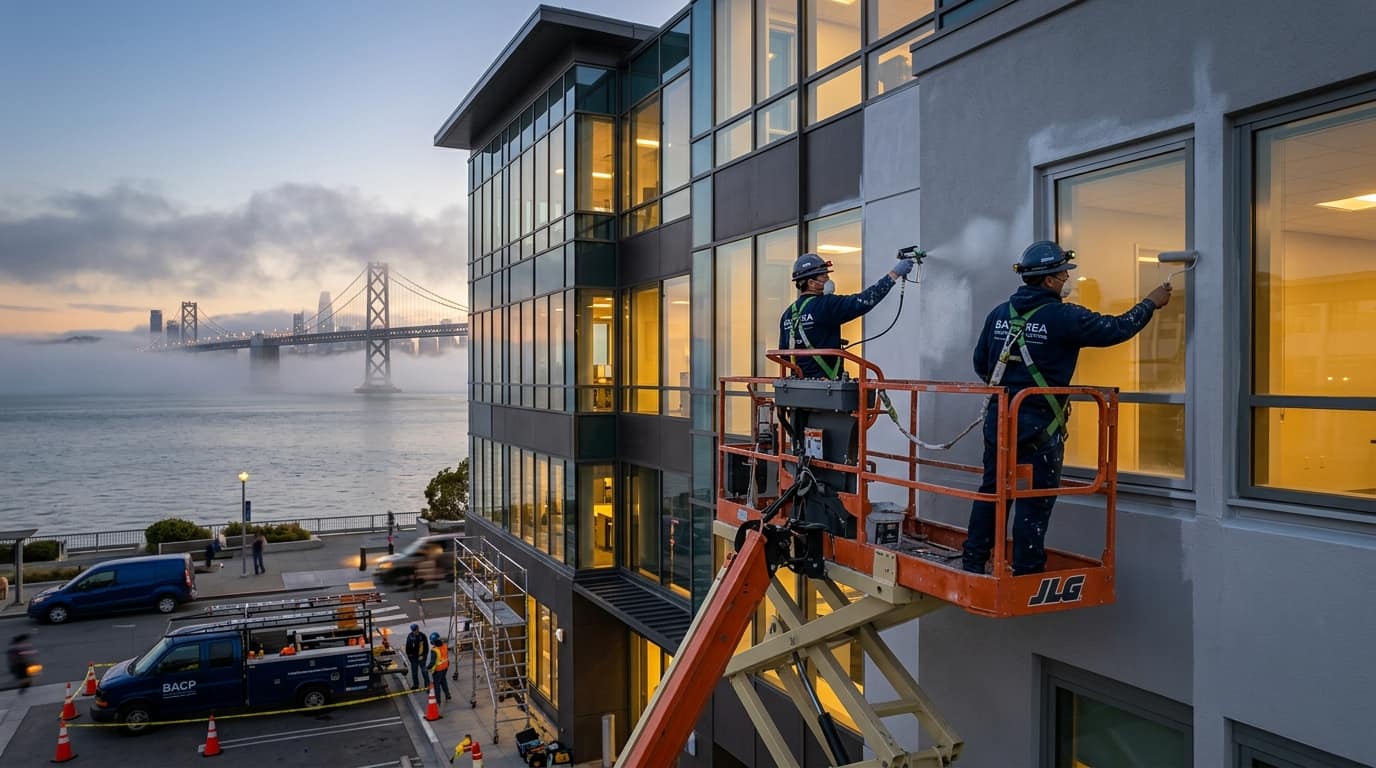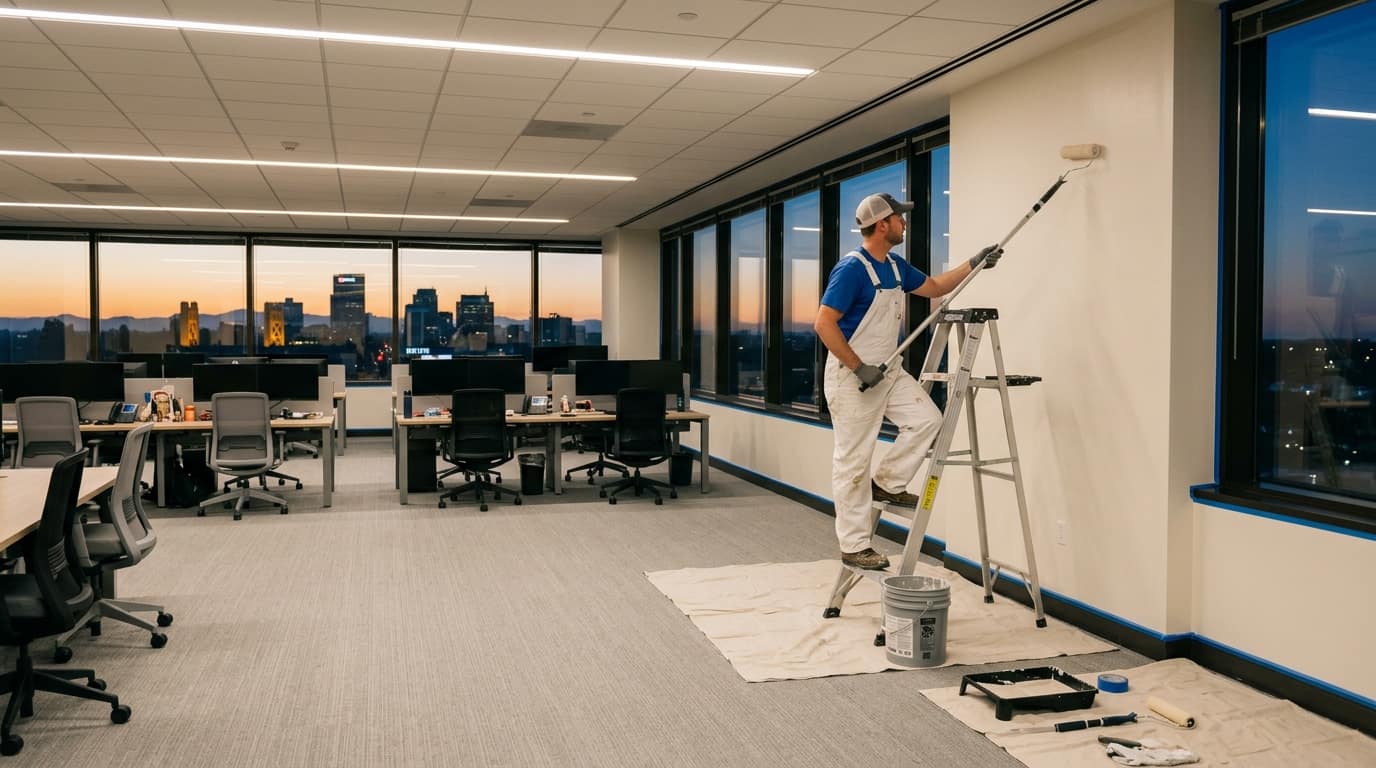

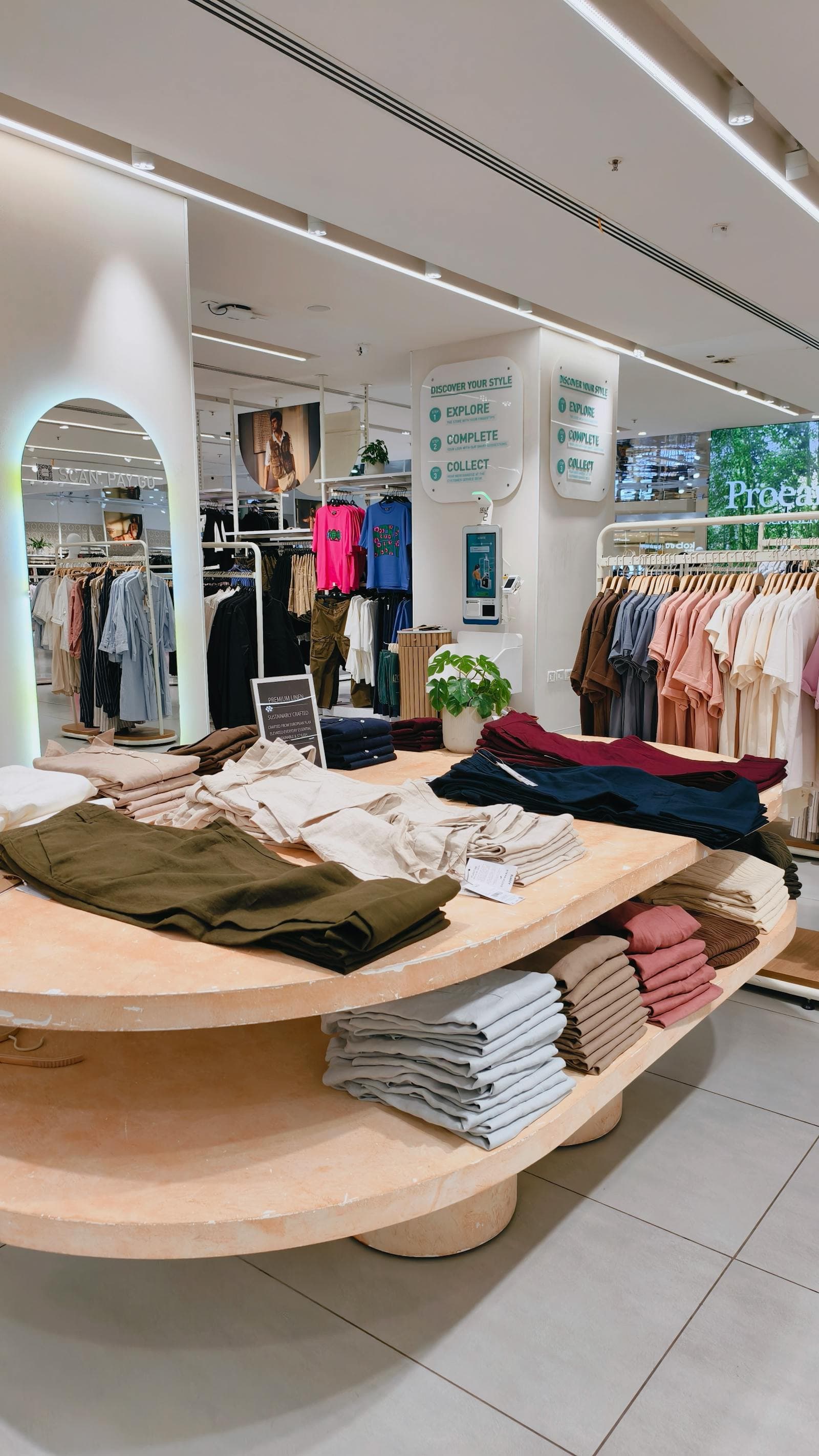
Retail store painting in Sacramento typically runs $3,500 to $25,000 depending on store size, brand color complexity, and whether the work happens during business hours or overnight. Most boutiques, specialty retailers, and shopping center tenants pay between $1.75 and $4.50 per square foot for a code-compliant interior repaint, with exterior storefront work running $2.50 to $6 per square foot when it includes Pantone-matched brand colors and ADA-compliant signage areas.
That is the quick answer. The longer answer involves how to phase a paint job around dinner traffic at Pavilions or Country Club Plaza, what it actually takes to nail a national brand standard like Sherwin-Williams Color ID matching for Lululemon or West Elm, and why ADA Title III rules govern more than just door clearances when the storefront gets repainted.
This guide covers real 2026 Sacramento retail painting pricing, how off-hours scheduling actually works in shopping centers, the Pantone-to-paint color matching process for brand-controlled stores, and the ADA signage compliance details that catch most operators off guard.
Why Retail Painting Is Different From Standard Commercial Work
A retail store is a brand experience, a sales engine, and a regulated commercial space all in the same 1,500 square feet. Treating it like a standard office repaint is how contractors get fired the morning after the soft opening. The three pressures that shape every decision:
- Revenue runs through the door every hour the store is open. Closing for paint is closing for sales. Phased and overnight scheduling is the norm, not the exception.
- Brand standards are absolute. A boutique with the wrong shade of taupe on the accent wall can fail a corporate audit and trigger an immediate repaint at the franchisee's expense.
- ADA Title III applies to public-facing commercial space. Wall finishes adjacent to signage, contrast at door frames, and reflective glare on display walls all matter.
Add to that the reality that retail tenants usually have landlord approval clauses, shopping center association rules, and limited storage space for furniture and fixtures during the project, and a "simple" repaint becomes a coordination job. ProFlow has seen Sacramento boutique owners try to use a residential painter on a regional clothing brand storefront only to repaint the entire interior six months later when corporate quarterly visits flagged a four-shade-too-warm wall color.
Retail Store Painting Cost in Sacramento: 2026 Pricing
Sacramento retail painting prices vary by store size, brand color complexity, scheduling constraints, and whether the project includes both interior and exterior work. Here are realistic 2026 ranges based on current market rates across the Sacramento metro.
| Store Type | Square Footage | Interior Repaint | Interior + Exterior | Brand-Standard Upgrade |
|---|---|---|---|---|
| Pop-up / kiosk | 200-400 sq ft | $1,200-$2,800 | $1,800-$4,200 | $2,500-$5,500 |
| Small boutique | 800-1,200 sq ft | $2,800-$6,500 | $4,200-$9,500 | $6,000-$13,000 |
| Specialty retail | 1,500-2,500 sq ft | $4,500-$10,000 | $7,500-$16,000 | $10,000-$22,000 |
| Mid-size anchor | 3,000-5,000 sq ft | $8,500-$18,000 | $14,000-$25,000 | $18,000-$34,000 |
| Department / big box tenant | 6,000-10,000 sq ft | $16,000-$32,000 | $24,000-$48,000 | $32,000-$65,000 |
| Multi-tenant strip facade | varies (linear ft) | n/a | $4,500-$22,000 | $8,000-$30,000 |
Sacramento commercial painting averages $1.45 per square foot for standard interior work (Homeyou, 2026), but retail consistently sits 25 to 80 percent higher because of brand color premiums, after-hours labor differentials, and the surface prep required to deliver a showroom finish.
For a broader look at commercial pricing across building types, see our commercial painting cost guide.
What Drives Retail Painting Costs Up
Several factors push storefront and boutique projects above standard commercial rates:
- Pantone or brand-spec color matching. Custom-tinted gallons run $40 to $120 over standard premium paint, and some national brand standards require specific manufacturer lines (Benjamin Moore Aura, Sherwin-Williams Emerald) that already cost 30 to 50 percent more per gallon.
- After-hours and overnight scheduling. Most Sacramento commercial painters charge a 15 to 25 percent premium for work performed outside 7 a.m. to 6 p.m. weekday hours.
- Higher-grade prep. Retail walls show every flaw under accent lighting. Skim coating, level-five drywall finish, and stain blocking add labor that office repaints rarely need.
- Fixture protection and merchandise relocation. Clothing racks, glass display cases, and electronic POS systems require careful covering or temporary moves.
- Ceiling work in tall storefronts. Sacramento shopping centers like Arden Fair and Roseville Galleria have 14 to 20 foot ceilings that need lifts and additional crew time.
- ADA-compliant finish work. Contrast requirements at signage, door frames, and accessible route walls add coordination with sign vendors.
- Corporate brand audits. Some national tenants require a corporate sign-off photo set, color drawdowns, and submittal documentation before final payment.
What Brings Costs Down
- Painting during a planned remodel or fixture refresh to share prep and protection costs
- Choosing a manufacturer's stock equivalent to the brand Pantone instead of full custom tint
- Phasing the project across two short overnights instead of one extended weekend
- Bundling multiple stores in the same shopping center for a portfolio rate
- Maintaining a regular 3 to 4 year repaint cycle so each project needs less prep
- Keeping ceilings and back-of-house in their existing color rather than refreshing every surface
Off-Hours and Overnight Scheduling: How Sacramento Retail Actually Gets Painted
The single most asked question we get from Sacramento store managers is whether painters can work after hours so the store does not have to close. The answer is yes, and for most retail projects it is the only realistic approach. Here is how off-hours scheduling actually works.
Can Painters Work After Hours in Sacramento Retail?
Yes. Most Sacramento commercial painting contractors run dedicated overnight crews for retail, restaurant, and office work. Standard overnight shifts run 9 p.m. to 6 a.m., giving the store time to close out registers, vacuum, and clear high-traffic zones before painters arrive, plus an hour at the end for cleanup and HVAC airing before the next morning's open.
For shopping center tenants, off-hours access depends on three things:
- Mall hours and security protocols. Country Club Plaza, Arden Fair, and Roseville Galleria each have specific after-hours vendor procedures requiring badged access and pre-registered crew lists.
- HVAC operation overnight. Some shopping centers shut down central HVAC after hours, which slows paint drying. Crews may need portable fans or supplemental airflow.
- Common-area noise and fume rules. Strip center associations often restrict spray application after specific hours and require zero-VOC products in shared-wall configurations.
Overnight Phasing for a 2,000 Sq Ft Specialty Retailer
Here is the scheduling framework ProFlow uses most often for Sacramento boutiques and specialty retailers. Adjust for your specific footprint, but this is the general structure:
-
Day 1 (afternoon, before close): Site walkthrough with store manager, confirm fixture protection plan, drop equipment in the stockroom.
-
Night 1 (9 p.m. to 6 a.m.): Furniture and fixtures pulled from the perimeter walls, drop cloths laid, dust barriers up. Drywall repair, stain blocking, sanding, and primer applied.
-
Day 2 (open): Store operates as normal. No visible work in customer zones because primer dries clear and prep is hidden behind protection.
-
Night 2 (9 p.m. to 6 a.m.): First coat of brand-spec color applied to all customer-facing walls. Overnight drying with fans and HVAC running.
-
Night 3 (9 p.m. to 6 a.m.): Second coat applied. Touch-ups, trim, and any accent walls. Furniture restored, drop cloths removed, store reset for opening.
-
Day 3 (open): Store reopens on schedule. Punch list walk-through with store manager during slow morning hours.
-
Day 4 (afternoon): Final touch-ups if needed during off-peak hours. Project closeout documentation delivered.
Total elapsed time: 4 calendar days. Actual paint work: 3 overnight shifts. Customer-facing closures: zero.
For a related look at how off-hours phasing varies by building type, see our commercial painting maintenance schedule which covers retail, office, and warehouse repaint cycles side by side.
When a Full Closure Actually Makes Sense
Overnight scheduling is the default, but a planned 1 to 2 day closure sometimes beats stacking three overnights. The math tips toward closing when:
- The store has a slow weekday (most boutiques close earliest revenue on Tuesday or Wednesday)
- Square footage exceeds 4,000 and overnight crews cannot finish before open
- Brand-spec paint requires extended dry times that conflict with overnight reopening
- Fixture relocation is extensive enough that resetting the floor each morning costs more in labor than a closed day
A Folsom shopping center anchor tenant we worked with last year ran the math on three overnights at 25 percent premium versus one Tuesday closure at zero premium plus one overnight, and the closure plan came in $2,400 cheaper with a better finish. Always do the math.
Brand Color Matching: How Painters Hit Pantone and Corporate Standards
National retail tenants and specialty boutiques operate under brand color standards that are often specified in Pantone Matching System (PMS) numbers, manufacturer-specific paint codes (Sherwin-Williams Color ID, Benjamin Moore color), or proprietary brand palettes maintained by corporate design teams. Hitting these accurately is the difference between a passed corporate audit and a forced repaint.
How Do Painters Match Brand Colors Accurately?
Three methods, listed from least to most accurate:
-
Manufacturer color database lookup. If the brand specifies a Sherwin-Williams or Benjamin Moore code, the paint store mixes from the formula and the result is repeatable across stores. This is the easiest and cheapest path.
-
Pantone-to-paint conversion. When the brand provides only a PMS number, the paint counter uses a conversion chart or proprietary software to find the closest manufacturer match. Accuracy varies. Some Pantones have very close paint equivalents; others are off by enough that a corporate audit catches them.
-
Spectrophotometer color reading. The paint counter scans an actual brand sample (a swatch, a vendor-supplied chip, or a clean section of existing wall) with a spectrophotometer like the X-Rite Ci64 and pulls a custom formula. This is the gold standard for proprietary brand colors and the only reliable path for stores with locked-down corporate palettes.
Citation capsule: The Pantone Matching System publishes a Color Bridge guide that converts PMS spot colors to closest CMYK and RGB equivalents, but paint conversion still depends on manufacturer-specific tinting bases (Pantone, 2024).
Drawdowns and Corporate Approval
For high-stakes brand work, the painter pulls drawdowns: a small sample of the mixed paint on a primed sample card, dried and labeled with the formula. Sacramento boutique owners and franchise operators submit drawdowns to corporate brand teams for sign-off before full application begins.
The drawdown process catches three common problems:
- Substrate effects. The same paint reads differently on smooth drywall versus orange-peel texture versus board-and-batten.
- Lighting effects. Most retail spaces use 3000K to 4000K LED accent lighting that shifts color perception versus daylight or 2700K incandescent.
- Tint base mistakes. A medium-base mix that should have been deep-base reads visibly different from the original specification.
ProFlow includes drawdowns on every brand-spec retail project at no extra charge because catching a mismatch on a 4-by-6 inch sample card is dramatically cheaper than catching it on a 200 square foot finished wall.
Common Sacramento Retail Brand Standards
Here is a quick reference for what we see most often in Sacramento shopping centers and standalone boutiques:
| Brand Type | Typical Spec | Sacramento Stores |
|---|---|---|
| National athleisure | Custom Pantone with corporate drawdown approval | Roseville Galleria, Arden Fair |
| Boutique fashion | Designer-specified Benjamin Moore or Farrow and Ball | Midtown, East Sacramento |
| Specialty food and drink | Manufacturer-stock with corporate sign-off | Country Club Plaza, Town and Country |
| Beauty and cosmetics | Sherwin-Williams Emerald with brand-tinted accents | Pavilions, Westfield Galleria |
| Tech and electronics | Pure white plus signature brand accent wall | Roseville Galleria, Folsom Premium Outlets |
| Home goods | Neutral palette with seasonal accent rotation | Arden Fair, Pavilions |
| Outdoor / lifestyle | Earth tones with branded accent | Folsom Premium Outlets, Stanford Ranch |
For Sacramento boutique owners working without a corporate brand standard, our best paint colors 2026 guide covers designer-favored neutrals and accent colors that perform well under retail lighting.
ADA Compliance for Retail Storefront Painting
The Americans with Disabilities Act Title III applies to any public-accommodation commercial space, which includes virtually every retail store in Sacramento. Most operators know about door clearances and aisle widths. Fewer know that paint and finish choices touch ADA compliance in three specific ways.
ADA Visual Contrast for Signage and Wayfinding
ADA Standards Section 703 requires that visual characters on signs have a non-glare finish and that characters and their backgrounds have a contrast ratio of at least 70 percent. The wall behind any mounted sign matters because:
- A glossy wall finish creates glare that reduces effective sign contrast
- A wall color too close to the sign background reduces the 70 percent contrast
- Reflective sheens can make signs unreadable from typical viewing angles
The practical answer: use eggshell, satin, or matte finishes (not high gloss) on walls adjacent to mounted ADA signage. Confirm the wall color does not match the sign background within the 70 percent contrast threshold.
Citation capsule: ADA Standards for Accessible Design Section 703.5.1 requires non-glare finish on visual characters and a 70 percent minimum contrast between characters and their background (U.S. Access Board, 2010 ADA Standards).
ADA Door Frame and Edge Contrast
While not a direct paint requirement, door frames and entry edges in accessible routes benefit from a contrast that helps low-vision customers locate openings. Many architects specify a contrasting frame color that the painter must match or maintain across the storefront facade.
ADA Restroom Wall Finishes
Public restrooms in retail stores must be accessible under ADA Title III. Wall finishes in accessible restrooms must be:
- Non-glare to prevent visual confusion for low-vision users
- Smooth and cleanable to support sanitation
- Color-contrasted from grab bars and fixtures where required by the local jurisdiction
Sacramento County and the City of Sacramento both adopt CBC Chapter 11B (California Building Code accessibility provisions) which incorporates ADA Title III requirements with some additional state-specific overlays. Any retail tenant improvement requiring permits gets reviewed against these standards.
For a related look at how compliance overlaps with broader commercial work, see our office painting Sacramento guide which covers tenant-improvement and landlord-approval scenarios in office space.
Best Paint Products for Sacramento Retail
Different zones in a retail store need different products. Customer-facing walls under accent lighting are not the same job as the back-of-house stockroom.
| Zone | Recommended Finish | Typical Product | Why |
|---|---|---|---|
| Customer-facing accent walls | Eggshell to matte premium acrylic | Benjamin Moore Aura, Sherwin-Williams Emerald | Color depth, true Pantone reads, durable wash |
| Customer general walls | Eggshell low-VOC acrylic | Sherwin-Williams Harmony, BM Natura | Scrubbable, color stability |
| Trim and reveal walls | Satin acrylic enamel | SW ProClassic, BM Advance | Scuff resistance against displays |
| Restrooms | Semi-gloss acrylic | BM Aura Bath and Spa | Mold resistance, sanitizer safe |
| Stockroom and back-of-house | Eggshell standard acrylic | SW ProMar 200, BM Ultra Spec | Cost-effective, scrubbable |
| Storefront facade | 100 percent acrylic exterior | SW Emerald Exterior, BM Aura Exterior | UV stability under Sacramento sun |
| Awnings and metal signage areas | Direct-to-metal acrylic or urethane | SW Pro Industrial DTM | Adhesion to aluminum and steel |
| Concrete columns and exposed structure | Masonry-rated acrylic | Loxon XP | Block filler plus elastomeric topcoat |
Sacramento's climate matters more on storefront exteriors than most operators realize. Summer surface temperatures on south-facing facades hit 140°F to 160°F, and the UV index reaches 10 to 11 from May through September. Standard exterior acrylics fade visibly within 18 to 24 months on those exposures, which is why most national brands now specify premium exterior lines like Aura Exterior or Emerald Exterior with extended fade warranties.
For a deeper look at which exterior paints survive Sacramento heat, see our best exterior paint for Sacramento climate guide.
Sacramento & Placer County
Need a real quote on your project?
Free, no-obligation walkthrough. Itemized estimate within 24 hours. Most jobs scheduled within 2–3 weeks.
How Long Does Retail Store Painting Take?
Timeline depends on store size, brand color complexity, and whether the work happens overnight or during a closure.
- 200 to 400 sq ft pop-up or kiosk: 1 overnight shift
- 800 to 1,200 sq ft boutique: 2 to 3 overnight shifts
- 1,500 to 2,500 sq ft specialty retail: 3 to 4 overnight shifts or 1 weekend closure
- 3,000 to 5,000 sq ft anchor tenant: 4 to 6 overnight shifts or 1 to 2 day planned closure
- 6,000 to 10,000 sq ft department or big-box tenant: 6 to 10 overnight shifts or 2 to 3 day closure
- Storefront exterior facade: 1 to 3 days depending on linear footage and prep
These timelines assume zero-VOC waterborne products with normal recoat times. Brand-spec products like Aura and Emerald typically dry to recoat in 2 to 4 hours under Sacramento overnight conditions, which is what enables the 9 p.m. to 6 a.m. shift to deliver two coats.
A 2,500 square foot Sacramento boutique with a single corporate brand color, two accent walls, and standard prep typically wraps in 3 overnight shifts plus one afternoon for touch-ups, with zero customer-facing closures.
Sacramento Shopping Centers and Why Location Matters
Sacramento has several major retail corridors where ProFlow works regularly, each with its own scheduling quirks and landlord rules.
Roseville Galleria (over 1.3 million square feet of retail). Strict overnight vendor procedures, dedicated security check-in, and HVAC scheduling that requires advance coordination. National tenant brand standards drive most of the painting work here.
Arden Fair Mall. Established mall with mixed national and local tenants. After-hours access through dedicated service corridors. Common-area painting is managed by mall ownership; tenant interior repainting is by individual store owner request.
Westfield Galleria at Roseville and Folsom Premium Outlets. Higher-end retail concentration with stricter brand audit cycles. More frequent brand-spec repaints driven by corporate quarterly visits.
Country Club Plaza, Pavilions, and Town and Country Village. Open-air centers with local boutique concentration. More flexibility on overnight scheduling. Storefront exteriors are visible to street traffic and need higher prep quality on facade work.
Midtown and East Sacramento. Standalone boutiques and specialty retailers in older buildings. Potential for lead paint on pre-1978 storefronts. Tighter parking for crews and equipment, often resulting in slightly higher project pricing.
Elk Grove and Natomas retail corridors. Newer commercial real estate, simpler projects, lower costs on straightforward repaints.
Sacramento County hosts approximately 1,800 retail establishments across major shopping centers and corridors, with retail employment representing about 11 percent of the county workforce (California Employment Development Department, 2024). The volume of retail real estate in the region keeps painting pricing competitive and most stores have multiple qualified retail painting contractors available for bids.
When Retail Stores Need Lead Paint Testing
Any Sacramento retail building constructed before 1978 needs lead paint testing before a repaint that disturbs more than six square feet of interior painted surface. The EPA Renovation, Repair, and Painting Rule (RRP) applies, and the federal penalty for violations runs up to $13,000 per occurrence.
Testing runs $300 to $800 for a 2,500 square foot retail space and is a smart line item on any project in Midtown, East Sacramento, Old Sacramento, and any pre-1978 commercial building. ProFlow handles testing as a separate scope item on these projects. For detailed cost breakdowns and timing, see our lead paint testing Sacramento guide.
Retail Repaint Frequency: When Should You Repaint?
Retail walls wear faster than office space because of high traffic, fixture moves, customer contact, and visible scuffing under accent lighting. Here is a realistic Sacramento schedule:
| Zone | Repaint Frequency | Why |
|---|---|---|
| Customer-facing accent walls | Every 2-3 years | Brand audits, fixture moves, scuffing |
| Customer general walls | Every 3-4 years | Scuffing, daily customer contact |
| Trim and reveal walls | Every 3-4 years | Display impact, fixture damage |
| Restrooms | Every 3-4 years | Daily sanitizing, moisture |
| Stockroom and back-of-house | Every 5-7 years | Lower visibility, less customer impact |
| Storefront facade | Every 4-6 years | UV exposure, signage updates |
| Pop-up and seasonal stores | Every install (1-2x per year) | Brand reset between concepts |
These cycles run shorter than office space because retail brand standards demand a tighter appearance threshold. A boutique that tries to stretch an accent wall to 5 years almost always shows visible wear that affects merchandising and conversion rates.
For a deeper look at how repaint cycles compare across building types, see our commercial painting maintenance schedule.
Frequently Asked Questions
How much does it cost to paint a retail store in Sacramento?
Sacramento retail store painting runs $1.75 to $4.50 per square foot for interior work and $2.50 to $6 per square foot for exterior storefronts. A 1,200 sq ft boutique typically costs $4,200 to $9,500 for a full repaint including standard prep and brand-spec color matching. A 2,500 sq ft specialty retailer runs $7,500 to $16,000. A 5,000 sq ft anchor tenant runs $14,000 to $25,000. Brand-spec premium products like Benjamin Moore Aura or Sherwin-Williams Emerald add 30 to 50 percent over standard commercial paint, and after-hours scheduling adds another 15 to 25 percent. Pop-up and kiosk repaints start around $1,200.
Can painters work after hours in retail stores?
Yes. Most Sacramento commercial painting contractors run dedicated overnight crews specifically for retail and restaurant work. Standard overnight shifts run 9 p.m. to 6 a.m., with the store closing normally and reopening the next morning. Shopping centers like Roseville Galleria and Arden Fair require pre-registered crew lists, badged access, and adherence to mall security protocols. Most retail repaints finish in 2 to 4 overnight shifts with zero customer-facing closures. After-hours work typically adds 15 to 25 percent to the project cost compared to standard daytime hours.
How do painters match brand colors accurately?
Painters match brand colors using one of three methods. The most accurate is a spectrophotometer reading of an actual brand sample, which generates a custom paint formula keyed to specific manufacturer tint bases. The second method is direct manufacturer code lookup when the brand specifies a Sherwin-Williams Color ID or Benjamin Moore color. The third is Pantone-to-paint conversion using PMS reference charts, which is less accurate for proprietary brand palettes. For high-stakes brand work, painters pull drawdowns (small dried samples on primed cards) for corporate sign-off before full application begins. ProFlow includes drawdowns on every brand-spec retail project.
How long does retail store painting take?
A 1,200 sq ft Sacramento boutique typically wraps in 2 to 3 overnight shifts. A 2,500 sq ft specialty retailer takes 3 to 4 overnight shifts or one weekend closure. A 5,000 sq ft anchor tenant runs 4 to 6 overnight shifts or a 1 to 2 day planned closure. Storefront exterior work adds 1 to 3 days depending on linear footage. Most projects cause zero customer-facing closures when scheduled overnight, with paint work concentrated in the 9 p.m. to 6 a.m. window and the store reopening on its normal schedule the following morning.
Do retail stores need permits to repaint?
Standard interior repainting of an existing retail store in Sacramento does not require a building permit. Exterior storefront repainting also typically does not require a permit unless the work involves significant facade changes, signage installation, or modifications to the building envelope. Tenant improvement projects that include drywall changes, new partition walls, or alterations to the accessible route trigger a plan check. Shopping center tenants almost always need landlord approval and may need to comply with property association color and finish standards even when no city permit is required. When in doubt, ask your painting contractor to confirm jurisdictional and landlord requirements before work begins.
What paint should I use in a retail store?
Customer-facing walls in Sacramento retail stores benefit from premium acrylic products like Benjamin Moore Aura or Sherwin-Williams Emerald in eggshell or matte finish, which deliver true brand color reads under accent lighting and survive years of customer contact. Trim and reveal walls take a satin acrylic enamel for scuff resistance. Restrooms need a semi-gloss with mold and moisture resistance. Stockroom and back-of-house can use standard commercial acrylic in eggshell. Exterior storefronts need a 100 percent acrylic with strong UV resistance, like Aura Exterior or Emerald Exterior, to handle Sacramento's summer heat and high UV index without fading.
Does ADA apply to retail painting?
Yes, ADA Title III applies to any public-accommodation commercial space including retail stores. Paint and finish choices touch ADA compliance in three ways: visual contrast on walls behind mounted signage (70 percent minimum under ADA Section 703), non-glare wall finishes adjacent to ADA signage to prevent reflection, and accessible restroom wall finishes that support sanitation and low-vision wayfinding. California Building Code Chapter 11B incorporates ADA Title III requirements with some state-specific overlays for Sacramento County and City of Sacramento jurisdictions. Retail tenant improvements requiring permits are reviewed against these standards.
Schedule Your Sacramento Retail Painting Project
Retail store painting in Sacramento is not standard commercial work. It requires brand-spec color matching, overnight scheduling that protects revenue, ADA-aware finish choices, and the kind of showroom-grade prep that survives accent lighting and corporate audits. Getting it right protects your sales, your brand standard, and your relationship with the landlord and the corporate office.
ProFlow Painting works with boutiques, specialty retailers, anchor tenants, and shopping center operators throughout Sacramento, Roseville, Folsom, Elk Grove, and Arden-Arcade. We handle full interior repaints, brand-spec accent walls, storefront facade work, and pre-audit touch-ups, all scheduled overnight with zero customer-facing closures and zero-VOC products that meet shared-wall mall requirements. Get a free retail painting estimate and we will walk your store, pull color samples, and build a phased project plan that keeps your registers running.
Free quote · Sacramento & Placer County
Ready for a real estimate, not a guess?
Tell us about your project and we'll walk it with you in person. Itemized quote within 24 hours, no high-pressure sales.