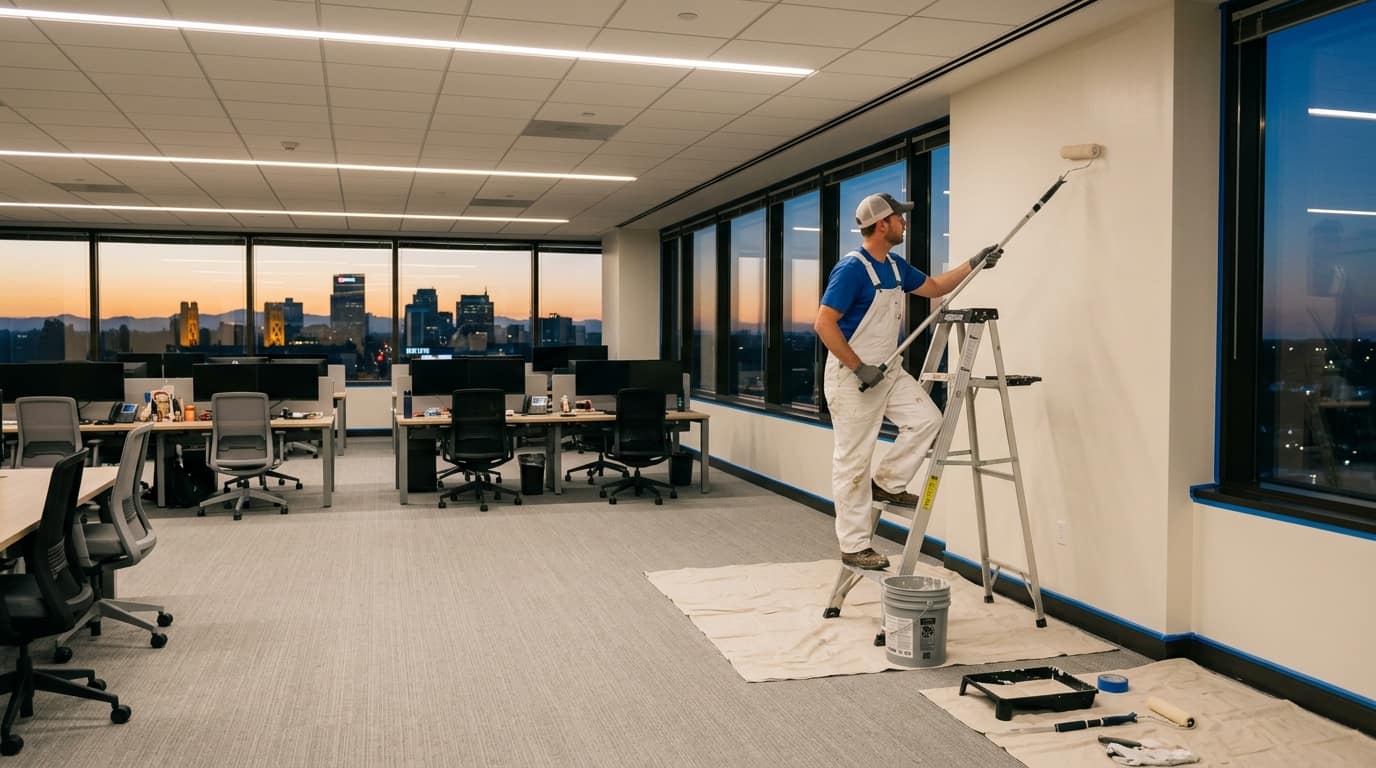

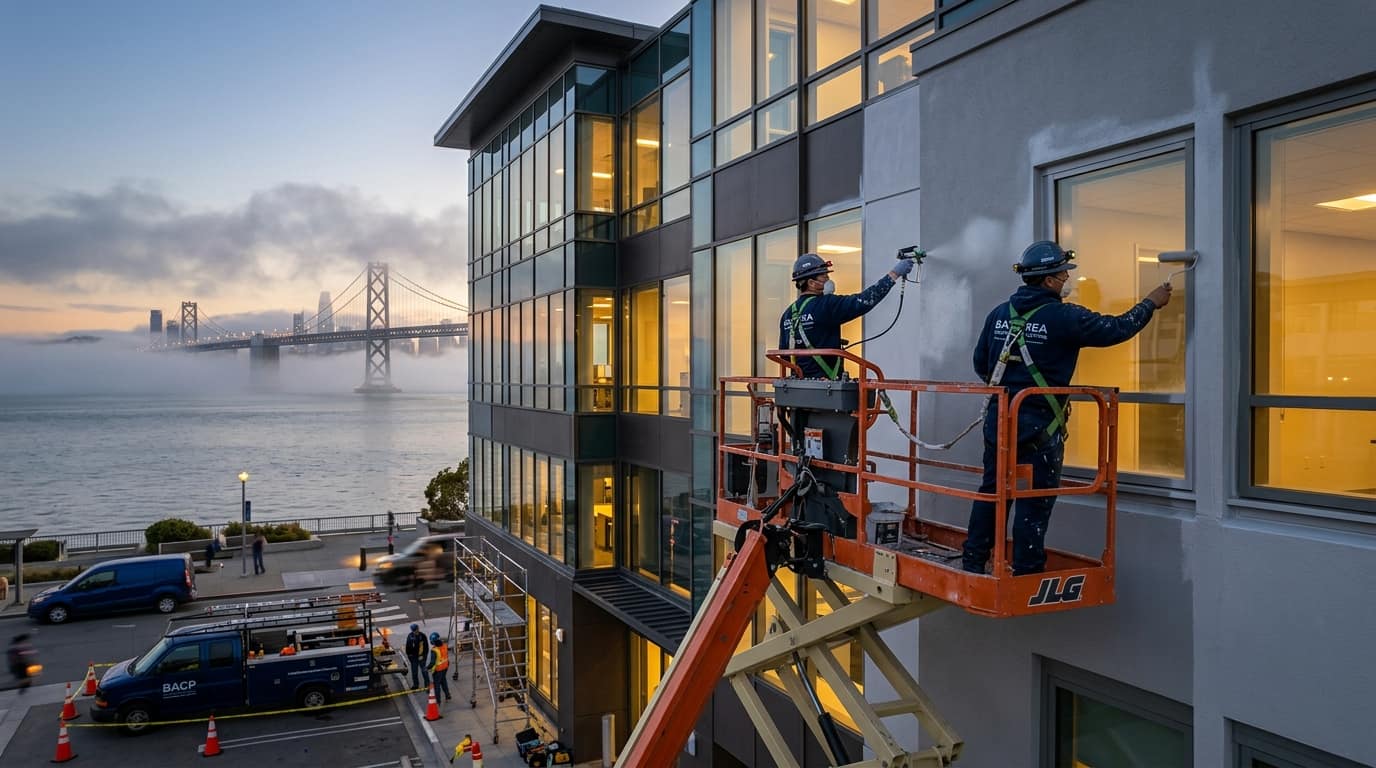
Bay Area commercial painting typically runs $2.25 to $5.75 per square foot for interior work and $3.50 to $9.00 per square foot for exterior, with the final number driven by marine air exposure, fog cycle timing, prevailing wage requirements on public-funded projects, and whether the building falls under San Francisco's historic preservation overlay or Prop 65 disclosure rules. Most Bay Area commercial projects also carry a 15 to 35 percent premium over comparable Sacramento work because of California prevailing wage on union jobsites, weekend and night scheduling for occupied retail and office space, and tighter Cal/OSHA lead and asbestos protocols on pre-1981 buildings.
That is the quick answer. The longer answer involves how a Sacramento-based contractor like ProFlow Painting actually staffs jobs in San Francisco, Oakland, and San Jose, what the marine layer and Bay Bridge fog cycle do to exterior coatings that work fine in Roseville, why commercial property managers in the East Bay and Peninsula increasingly hire Valley-based crews, and how prevailing wage actually flows through to a property owner's invoice on a Bay Area commercial repaint.
This guide breaks down 2026 commercial painting costs across San Francisco, Oakland, and San Jose, the Cal/OSHA and EPA rules that drive product and labor decisions, the climate-specific coating strategy our crews use for marine air zones, and how a Sacramento contractor builds a Bay Area project schedule that respects prevailing wage, weekend access, and tenant operations.
Why Sacramento Contractors Work the Bay Area
Bay Area commercial property managers have a labor problem. The Bureau of Labor Statistics reports that the San Francisco-Oakland-Hayward metro carries a mean wage of $33.95 per hour for painters, construction and maintenance, compared to $27.86 per hour in the Sacramento-Roseville-Folsom metro (U.S. Bureau of Labor Statistics OEWS, May 2024). That 22 percent labor cost gap is one reason a growing share of Bay Area commercial work goes to Valley-based contractors who keep their labor base in Sacramento, Roseville, Folsom, and Stockton, then mobilize to Oakland, San Francisco, or San Jose for the project window.
The other reasons are practical. Bay Area painting contractors are booked solid on residential repaint backlogs, while Valley contractors compete for fewer commercial accounts and respond faster on bid timelines. Sacramento crews routinely drive 80 to 110 miles each direction for jobs in Pleasanton, Oakland, San Jose, and San Francisco, with a 5:00 a.m. departure landing them at the jobsite before peak commute. ProFlow runs this pattern weekly across our East Bay service area, Peninsula and San Francisco coverage, and South Bay accounts.
For property managers and facility directors, the practical math looks like this:
- Valley contractor labor base costs 18 to 25 percent less than equivalent Bay Area crews
- Per diem and travel premiums add roughly 8 to 12 percent back on top
- Net: 8 to 15 percent total project savings for the property owner, with faster mobilization
- Same Cal/OSHA, prevailing wage, and CSLB licensing standards apply regardless of contractor origin
That savings is concentrated on standard commercial painting (offices, retail, warehouses, multi-tenant buildings). Highly specialized work like high-rise rope access, hazmat-grade abatement, or union-only jobsites still goes to local Bay Area specialists. The sweet spot for Valley contractors is the 5,000 to 50,000 square foot commercial repaint, tenant improvement, and exterior facade work where the Sacramento labor advantage actually moves the needle.
Bay Area Commercial Painting Cost: 2026 Pricing
Bay Area commercial pricing varies by city, project type, building age, and prevailing wage status. Here are realistic 2026 ranges based on current market rates across San Francisco, Oakland, and San Jose.
| Project Type | Square Footage | Standard Range | Prevailing Wage Range |
|---|---|---|---|
| Office tenant improvement | 5,000-10,000 sq ft | $11,500-$28,000 | $14,500-$36,000 |
| Mid-size office repaint | 10,000-25,000 sq ft | $22,000-$58,000 | $28,000-$74,000 |
| Retail storefront (2 stories) | 1,500-3,500 sq ft exterior | $9,500-$28,000 | $12,500-$36,000 |
| Multi-tenant retail | 8,000-20,000 sq ft exterior | $32,000-$95,000 | $40,000-$120,000 |
| Light industrial / warehouse | 15,000-50,000 sq ft | $34,000-$140,000 | $43,000-$180,000 |
| Hotel exterior repaint | 30,000-80,000 sq ft | $145,000-$520,000 | $185,000-$660,000 |
| Apartment complex (50-150 units) | 80,000-180,000 sq ft | $240,000-$720,000 | $310,000-$920,000 |
| Historic SF storefront | 1,800-4,000 sq ft | $14,000-$48,000 | $18,000-$60,000 |
Bay Area commercial averages sit notably higher than Sacramento equivalents. Comparable work in the Valley runs $1.40 to $3.85 per square foot interior, as detailed in our commercial painting cost guide. The Bay Area premium reflects four cost drivers: higher local labor rates when union crews are involved, prevailing wage on any project tied to public funding or tax-increment financing, Cal/OSHA compliance on older building stock with lead-based paint, and weekend or night scheduling for occupied retail and office space.
What Drives Bay Area Commercial Costs Up
Several factors push Bay Area commercial work above Valley pricing:
- Prevailing wage on public works, school district, transit, port, and any project receiving state or federal funding. California Labor Code 1771 and 1773 apply to projects over $1,000. The 2026 Bay Area painter prevailing wage runs $58 to $74 per hour fully loaded depending on county and craft jurisdiction.
- Marine-grade coatings for buildings within 5 miles of the bay or ocean. These run 15 to 35 percent more per gallon than standard exterior acrylic.
- Lead paint compliance on pre-1979 buildings. Cal/OSHA Title 8 Section 1532.1 and EPA RRP rules add testing, certified crews, containment, and disposal costs.
- Historic preservation in San Francisco's RH-1, RH-2, NCD, and similar overlays. Color approval, Article 10 review, and certificate of appropriateness can add weeks to the schedule and require submittal documentation.
- Weekend and night scheduling for occupied office and retail space. Most Bay Area commercial painters charge 18 to 30 percent more for after-hours work.
- Parking and access logistics in San Francisco, downtown Oakland, and downtown San Jose. Permit parking, loading zone limits, and curb permit fees add equipment and labor time.
- Prop 65 disclosure on any product containing chemicals on the California Office of Environmental Health Hazard Assessment list. Most paint specifications now require Prop 65 documentation in the project submittals.
- Mobilization and per diem when Valley contractors deploy crews. Typically $40 to $85 per crew member per day for travel, lodging, and meals on multi-day Bay Area projects.
What Brings Bay Area Costs Down
Property managers and facility directors lower Bay Area commercial painting costs by:
- Hiring Valley-based contractors with lower labor base rates plus per diem
- Combining multiple buildings in a portfolio repaint to spread mobilization costs
- Scheduling exterior work between April and October when fog cycles are shorter
- Using bundled-zone bidding rather than separate scopes for each tenant
- Reserving prevailing wage labor only for the funded portion of mixed-source projects
- Negotiating weekend mobilization in advance instead of mid-project change orders
- Booking the project window in advance with off-peak scheduling discounts
The Bay Area Climate: Why Sacramento Coatings Sometimes Fail
Coatings that perform for 8 to 12 years on a Sacramento exterior can fail in 4 to 6 years on a San Francisco, Oakland, or Pacifica building. The cause is a combination of marine air, fog cycle wet-dry exposure, salt deposition, and UV at certain microclimate zones that punish standard acrylic differently than Valley sun.
The Bay Area microclimates that drive coating selection:
| Zone | Climate Pattern | Coating Implication |
|---|---|---|
| Outer Sunset / Richmond District | Cold fog, 60-80 percent humidity year-round | Marine-grade acrylic, anti-mildew additives |
| Pacifica / Half Moon Bay | Direct ocean exposure, salt mist | Marine-grade with elastomeric topcoat |
| San Francisco downtown | Wind-driven fog, urban grime | Self-cleaning low-dirt-pickup acrylic |
| Oakland hills | UV plus fog wedge | UV-stabilized acrylic with mildewcide |
| Berkeley / Albany flats | Bay breeze, moderate fog | Standard premium acrylic with fungicide |
| San Jose / Santa Clara Valley | Hotter, drier, less marine air | Standard premium acrylic adequate |
| Walnut Creek / Pleasanton | Warmer inland Bay, similar to Sacramento | Standard premium acrylic |
| North Bay (Marin / Sonoma) | Variable fog, wildfire exposure | Wildfire-rated and marine-grade options |
The fog cycle is the silent coating killer. A San Francisco west-facing facade can hit 95 percent humidity at 6:00 a.m., burn off to 45 percent by 2:00 p.m., and return to 85 percent by 7:00 p.m. That daily wet-dry-wet cycle drives moisture into substrate cracks, blooms efflorescence on stucco, and accelerates failure on any coating that lacks proper vapor permeability. Standard acrylic painted on a foggy substrate before 11:00 a.m. simply does not bond the way it does in Sacramento.
ProFlow crews working San Francisco and the Outer Sunset start exterior work no earlier than 11:00 a.m. and stop application by 5:00 p.m. on most days, regardless of what the morning weather forecast says. The temperature has to be above 50 F and humidity below 85 percent for waterborne acrylic to develop proper film formation. That cuts a useful Bay Area exterior workday to 5 or 6 hours instead of the 9 to 10 hours we get in Sacramento.
The product specification follows the climate. For a coastal Bay Area exterior, our standard is Sherwin-Williams Duration or Emerald in a marine-modified formulation, Benjamin Moore Aura Exterior with mildewcide, or PPG Manor Hall in fog-zone applications. For inland Bay Area work like Pleasanton, Dublin, or San Jose, standard premium acrylic performs comparably to Sacramento applications.
For a deeper look at climate-driven product selection, see our best exterior paint for Sacramento climate guide which covers UV and heat strategy that contrasts directly with Bay Area marine air planning.
Cal/OSHA Lead and Asbestos Rules on Pre-1979 Bay Area Buildings
The Bay Area has a much higher concentration of pre-1979 commercial buildings than Sacramento. San Francisco, Oakland, and Berkeley in particular have downtown cores built between 1900 and 1965 where lead-based paint and asbestos-containing materials are essentially universal until proven otherwise. Cal/OSHA and EPA rules govern any project that disturbs these materials.
The three rules that apply to commercial painting on pre-1979 Bay Area buildings:
- Cal/OSHA Title 8 Section 1532.1 (Lead in Construction). Applies to any work that disturbs lead-based paint. Requires worker training, exposure monitoring, written compliance plan, hygiene facilities, and respiratory protection above the action level of 30 micrograms per cubic meter.
- EPA RRP Rule (40 CFR Part 745). Applies to renovation, repair, and painting in target housing and child-occupied facilities (schools, daycares, pediatric clinics). Requires EPA-certified renovator on jobsite, lead-safe work practices, and signed RRP disclosure.
- Cal/OSHA Title 8 Section 1529 (Asbestos in Construction). Applies to any disturbance of asbestos-containing materials including some pre-1981 stuccos, joint compounds, and certain coatings. Requires AHERA-trained crews, regulated work area, negative pressure containment for Class I and II work, and licensed disposal.
EPA RRP penalties run up to $46,989 per violation per day under the 2024 inflation adjustment (U.S. EPA Civil Monetary Penalty Inflation Adjustment, 2024). Cal/OSHA Section 1532.1 willful violations run up to $158,727 each. The compliance cost on a properly handled Bay Area lead project is small compared to the penalty exposure of doing it wrong.
In practice, every Bay Area commercial project ProFlow takes on a pre-1979 building starts with XRF lead testing ($400 to $900 for a typical commercial building) and asbestos sampling if any historic stucco, plaster, or troweled material is present. Test results dictate the rest of the project plan. If lead is present and disturbance exceeds the trigger thresholds, the work shifts into Cal/OSHA compliance mode with proper containment, certified crews, and disposal documentation.
For a homeowner-focused breakdown of the same testing process, see our lead paint testing Sacramento guide.
Prevailing Wage on Bay Area Commercial Painting
California prevailing wage is the rule that catches most property owners off guard on Bay Area commercial work. California Labor Code Sections 1771 and 1773 require contractors to pay prevailing wages on any public works project costing more than $1,000, where "public works" includes any construction, alteration, demolition, installation, or repair work paid for in whole or in part out of public funds.
The list of projects that trigger prevailing wage in the Bay Area is wider than most owners realize:
- Any project funded by federal, state, county, or city dollars
- School district facilities (K-12 and community college)
- Transit authority buildings (BART, Muni, AC Transit, VTA)
- Port and airport tenant improvements
- Affordable housing projects with tax credits or HUD funding
- Redevelopment projects with tax-increment financing
- Some prevailing wage triggered private projects over $25,000 if funded by certain public-private partnerships
- Project labor agreement projects where local agencies require PLA compliance
The current Bay Area prevailing wage rate for painters runs roughly $58 to $74 per hour fully loaded (base, fringe benefits, and training fund), depending on county and specific craft determination (California Department of Industrial Relations, 2026 determinations). Compare that to a typical non-prevailing-wage Bay Area commercial painter at $42 to $54 per hour fully loaded, or a Sacramento-based crew at $36 to $48 per hour fully loaded, and the project economics become clear.
What this means for property owners on Bay Area commercial work:
- Confirm whether the project triggers prevailing wage before bids go out, not after award
- Get certified payroll documentation from the contractor on prevailing wage projects
- Understand that mixed-funded projects can split scope between prevailing and non-prevailing wage sections
- Budget 25 to 40 percent above non-prevailing wage estimates if the project triggers Section 1771
- Verify the contractor is registered with the California DIR Public Works Contractor Registration
ProFlow handles prevailing wage Bay Area projects with full DIR registration, certified payroll, and the documentation package required for public works compliance. We also handle non-prevailing wage commercial work where the project is privately funded and falls outside Section 1771.
San Francisco-Specific Considerations
San Francisco commercial painting carries unique requirements beyond standard Bay Area work. The city's Article 10 historic preservation framework, fog microclimate, and tight urban access shape every project.
Historic preservation overlays. San Francisco's Planning Code Article 10 designates historic landmarks and Article 11 designates historic districts. Any exterior work on a contributory or landmark building requires Certificate of Appropriateness review by the Historic Preservation Commission. Color changes, finish changes, and substrate alterations all trigger review. Timeline runs 8 to 16 weeks for routine certificates, longer for full HPC hearings. Property managers planning a 2026 fall repaint on an Article 10 building should start the C of A application no later than May or June.
Color approval in NCDs. Several Neighborhood Commercial Districts (Castro, North Beach, Chinatown, Japantown) have additional color and signage rules layered on top of Article 10. The NCD specific plans are worth reviewing before the design phase commits to a palette.
Sidewalk and parking permits. San Francisco SFMTA color curb permits run $189 to $389 per day per blockface depending on zone. Sidewalk closure permits run additional fees and require ADA-compliant pedestrian routing. Most downtown commercial repaints budget $1,500 to $5,500 for permits on a multi-day exterior project.
Fog cycle scheduling. As noted above, west-facing facades west of Twin Peaks rarely paint successfully before 11:00 a.m. in the summer fog season. The June-July marine layer is brutal. Projects schedule for late September through October or April through May for the most reliable working windows.
Steep grades and access. San Francisco's hill grades shape the equipment plan. Many residential and small commercial buildings cannot accept standard scissor lifts and require boom lifts, swing stages, or rope access for upper floor exterior work. That equipment cost runs $850 to $2,400 per day on top of labor.
For our broader commercial painting service offering, see commercial painting and the related office painting Sacramento guide that covers tenant improvement work that crosses into Bay Area projects.
Sacramento & Placer County
Need a real quote on your project?
Free, no-obligation walkthrough. Itemized estimate within 24 hours. Most jobs scheduled within 2–3 weeks.
Oakland and East Bay Considerations
Oakland and the East Bay carry their own commercial painting patterns. Downtown Oakland has a dense cluster of pre-1965 commercial buildings, the Port of Oakland generates prevailing wage projects through its tenant improvement program, and the Oakland hills bring fog-and-UV challenges that contrast with the flatlands.
Downtown Oakland. Pre-1979 building stock concentrated in the Old Oakland, Uptown, and Jack London Square districts. Lead and asbestos testing is the standard starting point on any commercial repaint. Prevailing wage applies to any work tied to city redevelopment, BART tenant projects, or port-funded tenant improvements. Color approval is generally simpler than San Francisco except in the Old Oakland Historic District.
East Bay industrial corridor. The 880 corridor from Emeryville south through Hayward and Union City carries thousands of light industrial and warehouse buildings. Standard commercial coatings and scheduling work well in this zone. Marine air exposure varies by proximity to the bay, with buildings within 2 miles of the shoreline needing marine-grade specifications.
Berkeley and Albany. Older commercial building stock with stricter local color and design review in some neighborhoods (Solano Avenue, College Avenue, Telegraph). Berkeley specifically has design review requirements for commercial frontages that the city Design Review Committee oversees.
Pleasanton, Dublin, San Ramon, Walnut Creek. Tri-Valley and Diablo Valley commercial work behaves more like Sacramento commercial work climate-wise. Marine air exposure is minimal. Standard premium acrylic performs as expected. Prevailing wage still applies to any publicly funded project.
ProFlow runs Sacramento-based crews into the East Bay weekly. Our East Bay service area page covers the full city list including Oakland, Berkeley, Hayward, Fremont, Walnut Creek, Pleasanton, and Dublin.
San Jose and South Bay Considerations
San Jose and the South Bay anchor the South Bay commercial painting market. The climate runs warmer and drier than the bayfront cities, with fewer fog days, less marine air exposure, and standard commercial coatings performing on Sacramento-equivalent timelines.
The South Bay commercial work patterns:
-
Tech campus tenant improvement. Mountain View, Sunnyvale, Santa Clara, Cupertino, and Palo Alto host extensive corporate office portfolios. Tenant improvement painting runs continuous, with most projects on weekend or after-hours scheduling to avoid disrupting occupied space. Color and finish specifications often require corporate brand compliance documentation.
-
Retail centers and shopping plazas. San Jose, Campbell, Los Gatos, and Milpitas have dense retail center inventory. Repaint cycles run every 5 to 8 years on the exterior, with most projects scheduled in 2 to 4 weekend windows to avoid retail disruption.
-
Light industrial and R&D facilities. The Santa Clara and Milpitas industrial zones generate steady commercial painting work. Standard premium acrylic performs well on these inland buildings. Marine air is not a major factor.
-
Multi-family and apartment portfolios. San Jose has a large multi-family inventory. Apartment exterior repaints typically run on a 7 to 10 year cycle with prevailing wage applying to any project tied to affordable housing funding or city redevelopment.
-
Hotel exteriors. Silicon Valley hotels along North First Street, El Camino Real, and Stevens Creek Boulevard schedule exterior repaints in the September-October or April-May windows for best weather and lowest occupancy disruption.
ProFlow runs South Bay projects from our South Bay service area page, which covers Palo Alto, Mountain View, Sunnyvale, Santa Clara, Cupertino, Milpitas, San Jose, Campbell, and Los Gatos.
Weekend and Night Work for Retail and Office
Most Bay Area commercial painting projects on occupied space happen outside business hours. The math is straightforward: a single hour of disrupted retail revenue or unproductive office occupation costs more than the after-hours labor premium on the painting project.
Standard scheduling patterns by use type:
- Retail storefronts. Sunday night through Tuesday morning windows are typical. Some 24-hour pharmacies and grocery anchors require true overnight work between 1:00 a.m. and 5:00 a.m. with reopening before staff arrive.
- Office buildings. Friday evening through Monday morning weekend windows. Tenant improvement work often runs 5:00 p.m. Friday to 5:00 a.m. Monday for full weekend completion.
- Restaurants. Monday and Tuesday night closures, with Wednesday morning reopening. Some chain operations close for a full week and bundle painting with kitchen equipment maintenance.
- Hotels. Fall and spring shoulder seasons during low occupancy. Full lobby refreshes typically run 4 to 7 days with phased corridor work over 2 to 3 weeks.
- Schools. Summer break between June and August. Spring break and winter break for accelerated zones.
- Medical offices. Weekends and after-hours overnight, with detailed phasing covered in our medical office painting Sacramento guide.
- Warehouses and industrial. Sunday and weekend windows when production is paused. Some facilities run continuous and require live-floor work with isolated zone protection.
The cost premium for after-hours Bay Area commercial painting runs 18 to 30 percent above daytime rates. For a 12,000 square foot office tenant improvement, that is roughly $4,500 to $9,500 added to the project budget. Almost every Bay Area property manager pays this premium because the alternative is unworkable for tenant operations.
How a Sacramento Contractor Actually Runs a Bay Area Project
Here is how ProFlow handles a typical Bay Area commercial project from initial inquiry to final invoice. The pattern works for projects from 5,000 to 50,000 square feet and adjusts up or down for larger scopes.
-
Week 1, Initial site visit. Project manager drives to the Bay Area site for walkthrough, scoping, and substrate assessment. Photographs all elevations, identifies coating failures, checks for lead and asbestos triggers, and confirms access logistics including parking, elevator availability, and hours of operation.
-
Week 1-2, Estimating and submittals. Detailed estimate with line-item scope, prevailing wage status confirmation, product data sheets, and Cal/OSHA compliance plan if required. Color and finish samples coordinated with tenant or property manager.
-
Week 2-3, Contract and scheduling. Contract execution, certificate of insurance updated for Bay Area work, prevailing wage registration confirmed if applicable, weekend mobilization windows blocked on calendar. Permits filed for sidewalk closure, parking, or historic review where required.
-
Week 3-4, Pre-mobilization. Lead and asbestos testing completed if not already done. Materials ordered with marine-grade specifications confirmed. Crew briefing on Bay Area site logistics, prevailing wage classification, and any tenant-specific protocols.
-
Project window, Mobilization Friday. Crew loads truck Friday morning in Sacramento, drives to Bay Area site, and stages equipment by 9:00 a.m. Setup, masking, and prep through Friday afternoon. Crew lodging arranged for multi-day weekend projects.
-
Project window, Saturday and Sunday production. Main paint application during the working window. Marine air requires later starts on coastal sites. Continuous work with proper coatings selection. Pressure washing, prep, primer, two coats finish on most exterior projects.
-
Project window, Monday morning return to service. Final touchups, equipment demobilization, site cleaning, and walkthrough with property manager. Punch list captured. Crew returns to Sacramento Monday afternoon for the next week's projects.
-
Post-project, Documentation and warranty. Certified payroll filed if prevailing wage. Lead disposal documentation if applicable. Color and product warranty registration. Final invoice submitted with complete project documentation package.
The total timeline from initial site visit to project completion typically runs 4 to 6 weeks for a standard 10,000 to 25,000 square foot project. Larger portfolio work takes longer for scheduling and submittals. Emergency or fast-track Bay Area projects can compress to 2 weeks if the scope is straightforward and prevailing wage is not in play.
Bay Area Commercial Painting Repaint Cycle
Bay Area commercial buildings repaint on different cycles than Valley properties because of marine air, fog, and UV exposure. Here is a realistic schedule by use type and microclimate.
| Building Type | Coastal Bay Area | Inland Bay Area | Sacramento Equivalent |
|---|---|---|---|
| Office exterior | 5-7 years | 7-10 years | 8-12 years |
| Retail storefront | 4-6 years | 6-8 years | 7-10 years |
| Light industrial | 6-8 years | 8-12 years | 10-14 years |
| Warehouse exterior | 6-9 years | 9-13 years | 10-15 years |
| Hotel exterior | 5-7 years | 7-9 years | 8-11 years |
| Apartment complex | 6-8 years | 8-11 years | 9-12 years |
| Historic facade | 4-7 years | 6-9 years | 8-11 years |
The shorter Bay Area cycles reflect marine air exposure, fog cycle wet-dry stress, and salt deposition on coastal buildings. A property manager budgeting on Sacramento repaint cycles for a San Francisco or Pacifica building will see surface failure 3 to 5 years sooner than expected. Premium coating selection, proper prep, and timing the application within the right weather window all extend the cycle but cannot fully match inland performance.
For a longer look at commercial repaint planning across building types, see our commercial painting maintenance schedule which covers repaint frequency for offices, retail, warehouses, and healthcare buildings across the Sacramento and Bay Area markets.
Frequently Asked Questions
How much does commercial painting cost in the Bay Area?
Bay Area commercial painting runs $2.25 to $5.75 per square foot interior and $3.50 to $9.00 per square foot exterior depending on building type, age, and prevailing wage status. A 10,000 square foot office tenant improvement runs $22,000 to $48,000. A 2,500 square foot San Francisco retail facade runs $18,000 to $48,000. Prevailing wage projects add 25 to 40 percent on top of those ranges. Sacramento-based contractors like ProFlow typically deliver Bay Area projects 8 to 15 percent below local Bay Area contractor pricing because of lower labor base costs offset partially by per diem and travel.
Can a Sacramento painting contractor work in San Francisco, Oakland, and San Jose?
Yes, any contractor with an active California CSLB C-33 painting license can work statewide. Sacramento-based contractors regularly take on Bay Area commercial projects in San Francisco, Oakland, San Jose, and surrounding cities. The contractor must register with the California DIR for any prevailing wage work, carry insurance certificates valid in the project city, and follow all local Cal/OSHA, EPA, and historic preservation rules that apply at the jobsite. Mobilization typically uses a Friday-to-Monday weekend window with crew lodging for multi-day projects.
Do Bay Area commercial painting projects require prevailing wage?
Prevailing wage applies under California Labor Code 1771 to any public works project costing more than $1,000, including school district facilities, transit authority projects, port and airport tenant improvements, affordable housing with tax credits, redevelopment projects with tax-increment financing, and any project receiving federal, state, county, or city funding. Private commercial work funded entirely from private capital generally does not trigger prevailing wage. Bay Area painter prevailing wage runs $58 to $74 per hour fully loaded depending on county and craft determination, and that adds 25 to 40 percent to project costs compared to non-prevailing wage work.
What kind of paint works for Bay Area marine air and fog?
Bay Area exterior coatings need to handle daily wet-dry humidity cycles, salt deposition near the bay or ocean, and limited application windows because of fog. Marine-grade acrylic with mildewcide additives is the standard for buildings within 5 miles of the bay or ocean. Recommended product lines include Sherwin-Williams Duration and Emerald in marine-modified formulations, Benjamin Moore Aura Exterior with mildewcide, and PPG Manor Hall in fog-zone applications. Standard premium acrylic performs adequately on inland Bay Area buildings in the Tri-Valley, Diablo Valley, and South Bay where marine exposure is minimal.
How does Cal/OSHA lead paint compliance work on pre-1979 Bay Area commercial buildings?
Cal/OSHA Title 8 Section 1532.1 governs lead in construction work and applies to any project that disturbs lead-based paint on buildings constructed before 1979. Compliance requires worker training, exposure monitoring, written compliance plan, hygiene facilities, and respiratory protection above the action level of 30 micrograms per cubic meter. Projects also fall under EPA RRP rules in target housing and child-occupied facilities, requiring an EPA-certified renovator on the jobsite. Testing typically runs $400 to $900 for a commercial building. Penalties for noncompliance run up to $46,989 per EPA RRP violation per day and up to $158,727 for willful Cal/OSHA Section 1532.1 violations under 2024 inflation adjustments.
How long does a Bay Area commercial painting project take?
Project duration depends on scope. A 5,000 to 10,000 square foot office tenant improvement typically runs 1 to 2 weekends of paint work plus 4 to 6 weeknight evenings for prep and detail. A 10,000 to 25,000 square foot office repaint runs 2 to 4 weekends. A 30,000 to 50,000 square foot warehouse exterior runs 3 to 5 weekends with phased zones. Total project timeline from initial site visit to invoice typically runs 4 to 6 weeks including estimating, contract, scheduling, mobilization, work, and documentation. Prevailing wage projects add 1 to 2 weeks for DIR registration confirmation and submittal review.
Schedule Your Bay Area Commercial Painting Project
Bay Area commercial painting demands climate-specific coatings, prevailing wage compliance where applicable, weekend or night scheduling for occupied space, and Cal/OSHA discipline on pre-1979 buildings. Getting it right protects your tenants, your asset value, and your operating budget.
ProFlow Painting works with property managers, facility directors, and tenants throughout San Francisco, Oakland, San Jose, Berkeley, Palo Alto, Mountain View, Sunnyvale, Walnut Creek, Pleasanton, and the surrounding Bay Area cities. We field Sacramento-based crews on weekend mobilization, carry full DIR registration for prevailing wage projects, specify marine-grade coatings for coastal applications, and handle the Cal/OSHA and EPA documentation on pre-1979 building work. Get a free Bay Area commercial painting estimate and we will walk your property, identify the climate and compliance considerations, and build a phased project plan that respects tenant operations, prevailing wage where it applies, and your repaint cycle budget.
Free quote · Sacramento & Placer County
Ready for a real estimate, not a guess?
Tell us about your project and we'll walk it with you in person. Itemized quote within 24 hours, no high-pressure sales.