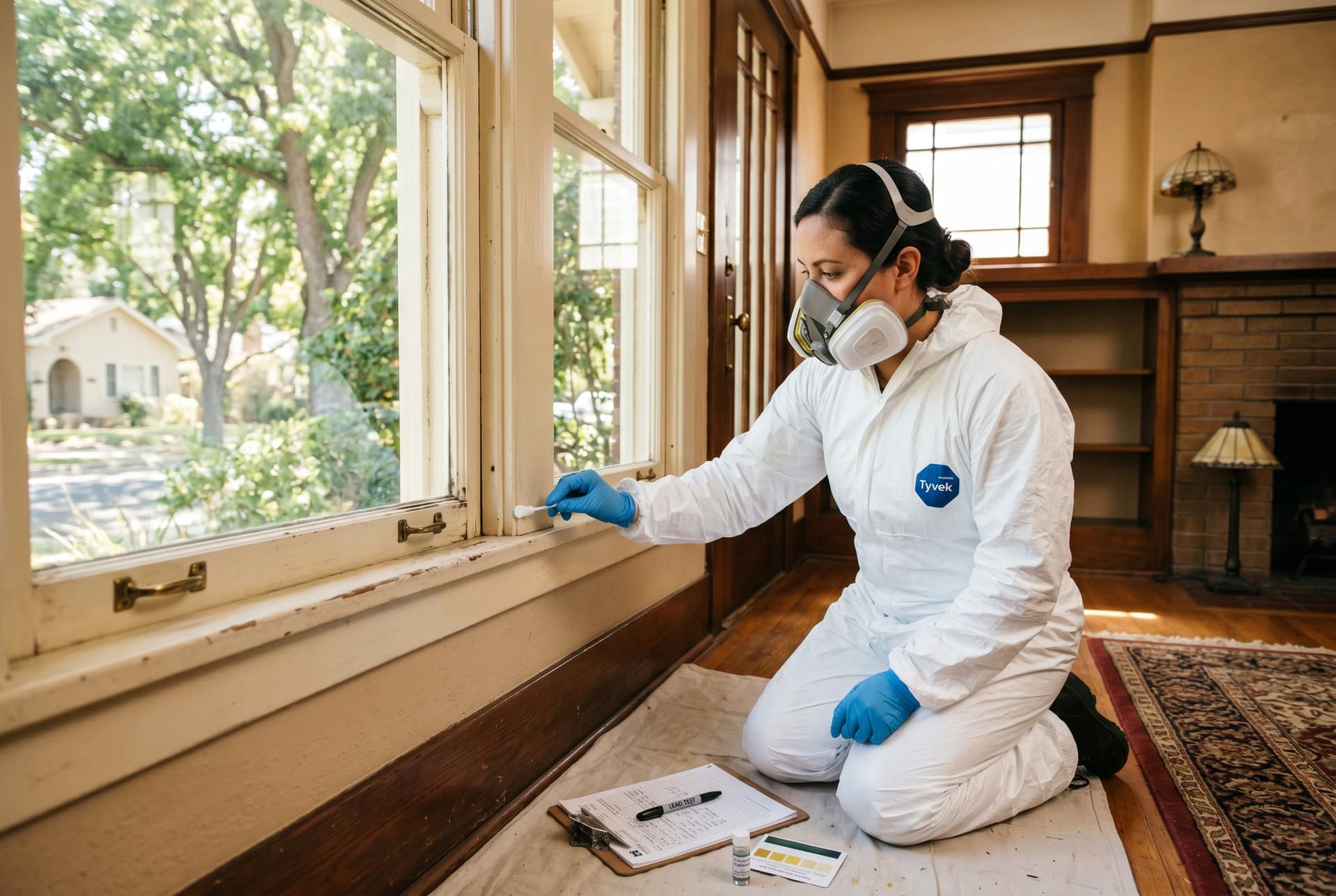


Nursery painting in Sacramento should be done 8 to 12 weeks before your due date using a true zero-VOC, GreenGuard Gold-certified paint such as Benjamin Moore Aura, Sherwin-Williams Harmony or Emerald, or Behr Premium Plus — and if your home was built before 1978, lead paint testing should happen before any sanding or scraping (EPA RRP Rule; CARB SCM 2020). Expect to pay $350 to $650 for a typical 8x10 nursery and $450 to $850 for a 10x12 room in the Sacramento metro, painted professionally with primer, ceiling, walls, and trim included.
Sacramento parents painting a baby's room face three issues most generic nursery guides skip. First, a large share of Sacramento's older grid neighborhoods — Land Park, Curtis Park, East Sacramento, Tahoe Park, Oak Park, Midtown — predate 1978, which means lead-based paint may be present and federal law dictates how it can be disturbed (EPA). Second, California's CARB SCM 2020 rule already caps VOC content in architectural coatings sold in the state at 50 g/L for flat and 100 g/L for non-flat — but "low-VOC" labels still allow chemicals you do not want a newborn breathing (CARB). Third, fresh paint emits VOCs and trace solvents for days to weeks after it looks dry, which is why timing matters as much as product choice (EPA Indoor Air, 2024).
This guide covers when to paint, what "zero-VOC" actually means under California's rules, the products our crews recommend for nurseries and kids' rooms, lead paint risks specific to pre-1978 Sacramento neighborhoods, room-by-room cost ranges, and an FAQ for new parents. If you're also pricing other rooms in the house, our interior painting cost guide for Sacramento covers whole-home pricing.
When Should You Paint the Nursery? The 8 to 12 Week Rule
Paint the nursery 8 to 12 weeks before your due date. That window gives the paint full time to off-gas, the room time to air out, and leaves a buffer if labor arrives early. The American Lung Association and EPA both note that VOC emissions from interior paint can continue for days to weeks after the paint feels dry to the touch, with the highest emissions in the first 48 to 72 hours (EPA, 2024; American Lung Association, 2024).
For a Sacramento family at week 28 of pregnancy, that means scheduling the painter no later than around week 30 to 32. Here's a practical timeline that matches how local nesting projects actually go.
The 8 to 12 week target serves three practical goals:
- Off-gassing buffer. Even zero-VOC paints have small amounts of trace solvents, ammonia, and glycols. Sacramento's mild fall and spring shoulder seasons allow days of window-open ventilation, which dramatically accelerates clearance (EPA, 2024).
- Construction contingency. If the painter finds lead paint, drywall damage, or texture issues, you have time to fix them properly rather than rushing.
- Pregnancy comfort. A pregnant person should not be in the room during painting or for at least 72 hours after. The earlier the project, the less complicated this is to arrange.
What If You Are Already in the Third Trimester?
If you are inside 4 weeks from your due date, the safest play is to skip the nursery paint job until 4 to 6 weeks postpartum and use a transition space for the first weeks home — a pack-and-play in the parents' room is medically recommended for the first 6 months anyway (American Academy of Pediatrics, 2022). A rushed paint job that overlaps with baby's arrival creates more risk than a slightly delayed nursery.
If painting absolutely has to happen close to the due date, hire a crew that will use only certified zero-VOC products, run negative-pressure ventilation, keep the pregnant occupant out of the home for 24 to 48 hours, and air the room for at least 5 days before the baby comes home.
Is Zero-VOC Paint Really Safer? CARB Limits Explained
Yes — zero-VOC paint is meaningfully safer than conventional paint, but the label rules in California are tricky. Under California Air Resources Board's Suggested Control Measure 2020 (SCM 2020), architectural coatings sold in the state cannot exceed 50 grams of VOCs per liter for flat finishes and 100 g/L for non-flat finishes (CARB SCM 2020). The federal limit is 250 g/L flat / 380 g/L non-flat. So "low-VOC" in California is already meaningfully cleaner than "low-VOC" elsewhere.
"Zero-VOC" under EPA rules means the paint contains less than 5 grams of VOCs per liter. That sounds clean — and it is — but two caveats matter for nurseries:
- "Zero-VOC" refers to the base paint only. Once tinted, some deep colors can add 5 to 15 g/L of VOCs. Stay with light, untinted or lightly-tinted colors for the cleanest result.
- "Zero-VOC" does not mean zero emissions. Paints can still off-gas ammonia, glycols, and trace solvents that fall outside the EPA's VOC definition. This is why GreenGuard Gold certification matters more than any single VOC number (UL GreenGuard Gold, 2024).
What GreenGuard Gold Actually Means
GreenGuard Gold is a third-party certification administered by UL Environment. To earn it, a paint must pass chamber emission testing for more than 360 individual VOCs, plus formaldehyde, total aldehydes, and respirable particles. The emission limits are set at levels safe for schools, hospitals, and nurseries — not generic commercial spaces (UL GreenGuard Gold UL 2818, 2024).
If a paint label says only "zero-VOC" or "low-VOC" but does not carry GreenGuard Gold or a similar emissions certification (e.g., MPI X-Green, Cradle to Cradle), the manufacturer has not been independently tested for nursery-safe emissions. Ask the painter to show you the technical data sheet — every reputable manufacturer publishes one.
Zero-VOC paint contains less than 5 g/L of VOCs but can still off-gas non-VOC emissions like ammonia and glycols. GreenGuard Gold certification (UL 2818) tests for over 360 individual chemicals at emission levels safe for schools and nurseries — it is the more meaningful label for baby's room paint (UL Environment, 2024).
Best Paint Products for a Sacramento Nursery (2026)
Three product lines consistently meet GreenGuard Gold or equivalent third-party certification and are widely available at Sacramento-area retailers. Our crews use all three on baby rooms and kids' rooms depending on budget and color selection.
Benjamin Moore Aura — Premium Tier
- VOC content: Zero-VOC base, low-VOC tinted
- Certifications: GreenGuard Gold
- Cost: Around $90 to $115 per gallon at Sacramento retailers
- Why it works for nurseries: Aura is self-priming on most surfaces, applies in two coats over light-to-dark color changes, and has the best color retention of any consumer paint we use. Color accuracy on deep pastels (the typical nursery palette) is unmatched (Benjamin Moore, 2024).
- Best for: Parents who want one application to last 8 to 10 years through the toddler-to-school-age room transitions.
Sherwin-Williams Harmony — Mid Tier
- VOC content: Zero-VOC formulation
- Certifications: GreenGuard Gold, MPI X-Green
- Cost: Around $70 to $85 per gallon
- Why it works for nurseries: Harmony actually contains a "formaldehyde-reducing technology" that absorbs ambient formaldehyde from carpet, MDF furniture, and other off-gassing sources — useful in a nursery full of new gear (Sherwin-Williams Harmony, 2024).
- Best for: Sacramento parents who are buying a new crib, dresser, glider, and changing table at the same time as painting.
Sherwin-Williams Emerald Designer Edition — Premium
- VOC content: Zero-VOC base
- Certifications: GreenGuard Gold
- Cost: Around $115 to $135 per gallon
- Why it works for nurseries: Best stain resistance of the three, scrubbable matte finish, designed for high-traffic walls. Pays off when the nursery becomes a toddler room.
Behr Premium Plus Zero VOC — Budget Tier
- VOC content: Zero-VOC base
- Certifications: GreenGuard Gold (Premium Plus line)
- Cost: Around $40 to $50 per gallon at Sacramento Home Depot locations
- Why it works for nurseries: Best DIY accessibility, decent coverage, and the GreenGuard Gold cert is genuine. Behr Premium Plus tested as a Consumer Reports value pick in interior paint categories (Consumer Reports, 2024).
- Best for: Budget-conscious families or rental nurseries.
| Product | VOC Class | Cost/Gallon (2026) | GreenGuard Gold | Best For |
|---|---|---|---|---|
| Benjamin Moore Aura | Zero-VOC | $90–$115 | Yes | Longevity, color accuracy |
| Sherwin Harmony | Zero-VOC | $70–$85 | Yes | Formaldehyde absorption |
| Sherwin Emerald Designer | Zero-VOC | $115–$135 | Yes | Scrubbability |
| Behr Premium Plus Zero VOC | Zero-VOC | $40–$50 | Yes | DIY budget |
| Generic "low-VOC" store paint | Low-VOC | $25–$40 | No | Not recommended for nurseries |
Source: Manufacturer technical data sheets and Sacramento retailer pricing surveys, 2026
Primer: Don't Skip It
A common mistake on nursery projects is skipping primer to save a day or a hundred dollars. For a nursery this is the wrong corner to cut. Primer creates a sealed barrier between the existing wall (which may contain decades of unknown coatings) and the new clean topcoat. Use:
- Zinsser Bulls Eye 1-2-3 Plus — zero-VOC, water-based, blocks stains and tannins
- Benjamin Moore Fresh Start — zero-VOC primer matched to Aura
A single coat of primer plus two finish coats is the nursery standard. Manufacturers' coverage warranties almost universally require primer on bare or previously-painted walls when going light-to-dark or dark-to-light.
Lead Paint Testing for Pre-1978 Sacramento Homes
Lead paint was banned for residential use in 1978, but 87% of pre-1940 U.S. homes still contain it, along with 69% of homes built 1940 to 1959 and 24% of homes built 1960 to 1978 (EPA, 2021). Several Sacramento neighborhoods have housing stock concentrated in exactly those eras:
- Land Park — heavy 1920s to 1950s Tudor, Spanish Revival, and ranch construction
- Curtis Park — late 1880s to 1930s Victorians and Craftsman bungalows
- East Sacramento (including Fab 40s) — 1910s to 1940s
- Tahoe Park — 1930s to 1950s mid-century
- Oak Park — 1900s to 1940s
- Midtown / Alkali Flat / Mansion Flats — Victorian-era through 1930s
- Hollywood Park / South Land Park — 1940s to 1960s post-war ranch
If your nursery is in any of these neighborhoods or in any Sacramento home built before 1978, lead paint testing should happen before any prep work, not after. Sanding, scraping, or even removing baseboards can release lead dust into the air the baby will eventually breathe. The EPA's RRP Rule requires that any project disturbing more than 6 square feet of interior surface in a pre-1978 home be performed by an EPA Certified Renovator (EPA RRP Rule). A typical nursery prep job — patching, sanding, removing trim — crosses that threshold easily.
In California, only CDPH-certified Lead Inspectors or Risk Assessors can legally test for lead paint (CDPH). Your painting contractor cannot do this even if they are EPA Certified — testing requires separate California certification. Budget $250 to $700 for XRF (X-ray fluorescence) inspection of a single room or $500 to $1,500 for a full home risk assessment (Angi, 2026).
For full pricing and process details, see our Sacramento lead paint testing guide.
What Happens If Lead Is Found
A positive lead test does not mean the nursery is unusable. Three options exist:
- Encapsulation — A specialized lead encapsulant coating seals existing paint in place. Costs $1 to $4 per square foot, lasts 10 to 20 years, works on intact non-friction surfaces (HomeAdvisor, 2025).
- Abatement — Full removal by a certified abatement contractor. Costs $6 to $17 per square foot. Required on friction surfaces like windows and doors.
- Component replacement — Replacing the window, door, or trim entirely rather than stripping it. Often the most economical option for a single nursery.
Nursery Painting Cost Sacramento: 8x10 and 10x12 Rooms
A typical Sacramento nursery falls into one of two size buckets: a small bedroom around 80 square feet (8x10) or a standard bedroom around 120 square feet (10x12). 2026 professional pricing for these rooms, including zero-VOC paint, primer, ceiling, walls, trim, and proper masking, runs as follows.
What's Included in a Full Nursery Repaint
A professional nursery paint job in Sacramento typically covers:
- Surface prep: Patching nail holes, caulking gaps, sanding rough spots, removing old wallpaper if present
- Masking: Plastic over floors, paper over baseboards, tape on switches and outlets, ceiling cut-line tape
- Primer: One coat of zero-VOC primer on bare patches, full coat if going light-to-dark
- Ceiling: Two coats of zero-VOC flat ceiling paint
- Walls: Two coats of zero-VOC eggshell or matte
- Trim: One to two coats of low-VOC semi-gloss on baseboards, door, and window casings
- Cleanup: Vacuum, wipe-down, debris removal
- Ventilation setup: Window fans or HEPA air scrubber for 24 to 48 hours post-paint (some pros include this; others charge $50 to $150 add-on)
Why Trim Costs More Per Square Foot
Trim painting takes longer per square foot than walls because of cut-in work around door jambs, window casings, and baseboard inside corners. Expect trim to add 25% to 40% to a walls-only quote. For Sacramento homes with original trim from the 1920s to 1940s, prep work (sanding, filling old paint drips, hand-sanding profiles) can add another $100 to $250.
For trim-specific pricing across other rooms, see our Sacramento trim and baseboard painting cost guide.
Accent Walls and Murals
A single accent wall — for example, a sage green wall behind the crib while the other three walls stay off-white — typically adds $75 to $200 to the base quote. A simple painted shape (mountain silhouette, half-painted wall with a clean horizontal line, color-block geometric) adds $150 to $400 depending on complexity and masking time.
Hand-painted murals are not standard for production painting crews. For a true illustrative mural, plan to hire a separate muralist (Sacramento has several working artists in the $40 to $75 per hour range, $500 to $2,500 per nursery wall depending on detail).
For more accent wall ideas and color combinations that work in Sacramento light, see our accent wall ideas Sacramento guide.
What Affects the High End vs. Low End
| Factor | Pulls Cost Up | Pulls Cost Down |
|---|---|---|
| Existing wall condition | Heavy patching, crayon, sticker residue | Clean walls, newer drywall |
| Old paint color | Dark accent wall to white | White to light pastel |
| Ceiling height | 9+ ft (Land Park, East Sac craftsmen) | Standard 8 ft |
| Trim style | Original 1930s craftsman profile | Modern flat MDF |
| Lead paint testing/abatement | Required for pre-1978 homes | Post-1978 home |
| Scheduling | Same-week rush | 4+ weeks lead time |
| Furniture removal | Painter handles | Owner clears room |
A typical 10x12 Sacramento nursery in a 1990s or newer home, with normal wall condition and standard trim, lands around $525 to $650 for a full professional repaint in 2026 — primer plus two coats of GreenGuard Gold-certified zero-VOC paint, ceiling and trim included. A pre-1978 East Sac craftsman with original trim, after lead testing, runs $750 to $1,100.
Sacramento & Placer County
Need a real quote on your project?
Free, no-obligation walkthrough. Itemized estimate within 24 hours. Most jobs scheduled within 2–3 weeks.
Safe Paint for Pregnant Women: What the Research Says
A pregnant person should not be in a room while it is being painted, regardless of how clean the paint is — and ideally should not return for at least 72 hours after painting. This is both a precaution against VOC exposure and against fume-triggered nausea, which is common in early-to-mid pregnancy.
The American College of Obstetricians and Gynecologists (ACOG) does not have a single bright-line rule on paint exposure but recommends pregnant people avoid exposure to organic solvents, oil-based paints, and paint strippers (ACOG, 2024). The CDC notes that occupational exposure to organic solvents has been associated with elevated risk of neural tube defects and miscarriage in studies of professional painters — but these are full-time, high-exposure scenarios, not a single nursery repaint (CDC NIOSH, 2024).
For a home painting project, the consensus among major obstetric organizations is straightforward:
- Do not personally paint during pregnancy if it can be avoided
- Do not be in the room during painting or for at least 72 hours after
- Use only certified zero-VOC, GreenGuard Gold paints when professionals paint
- Ventilate aggressively — windows open, fans running, ideally for 5 to 7 days
- Avoid oil-based paints entirely during pregnancy (rare in residential interior work, but verify)
What About the Partner or Older Kids?
A non-pregnant adult can be in the home during painting in a different room, with the door to the painting area closed and the painted room sealed off and ventilated to outside. Older children should be out of the home or in a sealed-off area during painting and for 24 to 48 hours after. Pets — especially birds, which have hyper-sensitive respiratory systems — should be out of the home for 48 hours.
For more on post-paint timing in any bedroom, see our guide on how long after painting can you sleep in a room.
Color Choices: What Actually Works for Nurseries
Nursery color trends move fast, but a few principles hold across years and have aged well in our Sacramento installs:
- Lighter is more practical. Babies do not need stimulating saturated colors — newborn vision is low-contrast for the first 3 months. Pale colors photograph better and survive 5 to 7 years of changing décor.
- Greens and blues outlast pink and gendered palettes. Even families who want a "girl's room" or "boy's room" often regret highly gendered colors when a second child arrives or the room repurposes.
- Avoid pure white in Sacramento light. South-facing windows in Sacramento push so much sun into rooms that pure white reads cold and clinical. A warm white (Benjamin Moore Simply White OC-117, Sherwin-Williams Alabaster SW 7008) photographs warmer.
- Test on the wall. Buy quart samples and paint 2-foot squares on multiple walls. Look at them at 8 AM, 1 PM, and 7 PM with a lamp on. Sacramento light shifts dramatically across the day.
2026 Sacramento Nursery Color Leaders
- Sage / sage olive — gender-neutral, calm, pairs with natural wood furniture
- Warm white — Benjamin Moore Simply White, Sherwin-Williams Alabaster
- Pale blue-green — Benjamin Moore Wythe Blue, Sherwin Sea Salt
- Soft terracotta / clay — warmer alternative to traditional pink
- Greige (gray-beige) — Benjamin Moore Edgecomb Gray, Revere Pewter
For broader 2026 color guidance, see our coverage of the Benjamin Moore 2026 Color of the Year (Silhouette AF-655) and Sherwin-Williams 2026 Color of the Year (Grounded). Either color works as a sophisticated nursery base for parents who want something less typical than pastels.
DIY vs. Hiring a Pro for the Nursery
A DIY nursery paint job for an 8x10 or 10x12 room costs $120 to $250 in materials (one gallon of zero-VOC paint, primer, rollers, tape, drop cloths, brushes). The pro rate of $350 to $850 covers labor, expertise, equipment, and the fact that the work happens in 1 to 2 days instead of a long weekend of pregnant-adjacent stress.
Three reasons most Sacramento families end up hiring a pro for the nursery specifically:
- Pregnancy timeline pressure. Nesting urges hit hard at weeks 28 to 34. A pro finishes in 1 to 2 days. DIY stretches across multiple weekends.
- Ceiling work. Painting a ceiling is the worst part of DIY paint work for anyone, and especially uncomfortable for a pregnant person or an exhausted partner.
- Lead and prep issues. A pre-1978 home requires EPA-certified prep that is not legal to DIY beyond the 6 square foot threshold without RRP certification.
For a full DIY-vs-pro cost comparison across more rooms, see our DIY vs professional painting Sacramento guide.
Frequently Asked Questions
When should I paint a nursery before baby arrives?
Paint the nursery 8 to 12 weeks before your due date. That window gives zero-VOC paint full time to off-gas, the room 5 to 7 days of aggressive ventilation, and leaves a contingency buffer if labor arrives early or if lead testing reveals issues that require remediation first. If you're inside 4 weeks of your due date, defer until 4 to 6 weeks postpartum and use a transitional sleep space — the AAP recommends room-sharing with parents for the first 6 months anyway (American Academy of Pediatrics, 2022). Even zero-VOC paints emit trace solvents for days to weeks after they feel dry (EPA, 2024).
Is zero-VOC paint really safer?
Yes, but the label is not enough on its own. Zero-VOC means less than 5 grams of VOCs per liter under EPA rules, while California's CARB SCM 2020 caps standard architectural coatings at 50 g/L flat / 100 g/L non-flat (CARB SCM 2020). The more meaningful certification for a nursery is GreenGuard Gold (UL 2818), which tests for over 360 individual chemicals — including formaldehyde and aldehydes that fall outside the EPA's VOC definition — at emission levels safe for schools, hospitals, and nurseries (UL Environment, 2024). Look for both "zero-VOC" and "GreenGuard Gold" on the label.
How much does it cost to paint a nursery in Sacramento?
A professional nursery repaint in Sacramento costs $350 to $650 for an 8x10 room and $450 to $850 for a 10x12 room in 2026, including zero-VOC paint, primer, ceiling, walls, trim, and proper masking. Walls-only quotes start around $275 (8x10) and $350 (10x12). An accent wall adds $75 to $200; a painted shape or color-block design adds $150 to $400; a hand-painted mural is typically a separate $500 to $2,500 add-on by a muralist. Pre-1978 Sacramento homes (common in Land Park, Curtis Park, East Sac, Tahoe Park) may add $250 to $1,500 for lead testing and remediation.
Does my Sacramento home have lead paint?
If your home was built before 1978, lead paint is a real possibility. 87% of pre-1940 U.S. homes contain lead-based paint, along with 69% of homes built 1940 to 1959 and 24% of homes built 1960 to 1978 (EPA, 2021). Sacramento neighborhoods with high pre-1978 housing stock include Land Park, Curtis Park, East Sacramento, Tahoe Park, Oak Park, Midtown, Alkali Flat, and parts of South Land Park. Visual inspection is not reliable — only a CDPH-certified Lead Inspector can test legally in California (CDPH). XRF testing runs $250 to $700, and the EPA's RRP Rule requires certified renovators for any pre-1978 work disturbing more than 6 square feet of interior surface. See our Sacramento lead paint testing guide for the full process.
Can I be in the house while the nursery is being painted?
A non-pregnant adult can be in the house in a different room with the painting area sealed off (door closed, window fan venting outside). A pregnant person should not be in the home during painting and should ideally stay elsewhere for 24 to 48 hours after. Older children should be out of the painted area for 24 to 48 hours. Pets — especially birds — should leave for 48 hours. The American College of Obstetricians and Gynecologists recommends pregnant people avoid exposure to organic solvents and oil-based paints (ACOG, 2024).
How long do I need to wait before putting the crib back in?
Allow 5 to 7 days of aggressive ventilation before bringing the crib, baby gear, and especially the baby back into a freshly painted nursery — even with zero-VOC GreenGuard Gold paint. Open windows, run a window fan venting outward, and avoid sealing the room until off-gassing is complete. For more detail on bedroom occupancy timing post-paint, see our how long after painting can you sleep in a room guide.
What paint finish should I use in a nursery?
Use eggshell or matte (low-sheen) on walls and semi-gloss on trim. Eggshell is scrubbable enough to handle the wipe-downs every parent will do over the next 3 years, but does not show every roller mark the way flat paint does. Semi-gloss on baseboards, door, and window trim handles toddler-stage finger smudges and is easy to wipe clean. Avoid full gloss — too reflective for a calming nursery feel. For finish selection across other rooms, see our Sacramento paint sheen guide.
Bottom Line for Sacramento Parents
Paint the nursery 8 to 12 weeks before your due date with a GreenGuard Gold-certified zero-VOC paint, get lead testing first if your home predates 1978, and budget $350 to $850 for a professional job depending on room size and trim work. Skip the budget "low-VOC" store brands — California's baseline rules already make those category labels almost meaningless. Look specifically for the GreenGuard Gold logo and the zero-VOC designation together.
The reason to hire this out rather than DIY is not the painting itself. It is the timing pressure of pregnancy, the lead-paint compliance work in older Sacramento neighborhoods, and the comfort of knowing the room is professionally ventilated and ready before baby comes home. In the last three years we have painted over 80 Sacramento nurseries, including pre-1978 craftsmen in East Sac, Curtis Park bungalows, Tahoe Park ranches, and newer Natomas and Elk Grove builds. The pattern is consistent: families who book at week 26 to 30 of pregnancy are calm. Families who call at week 36 are stressed about the same job.
If you are inside the planning window, call ProFlow Painting at (916) 740-7249 for a free nursery painting estimate. We are an EPA Certified Firm, work with CDPH-certified lead inspectors for pre-1978 homes, and stock GreenGuard Gold-certified zero-VOC product lines from Benjamin Moore and Sherwin-Williams. For broader pricing context across the home, see our full Sacramento interior painting cost guide and our eco-friendly painting Sacramento guide for additional zero-VOC product detail.
Free quote · Sacramento & Placer County
Ready for a real estimate, not a guess?
Tell us about your project and we'll walk it with you in person. Itemized quote within 24 hours, no high-pressure sales.