

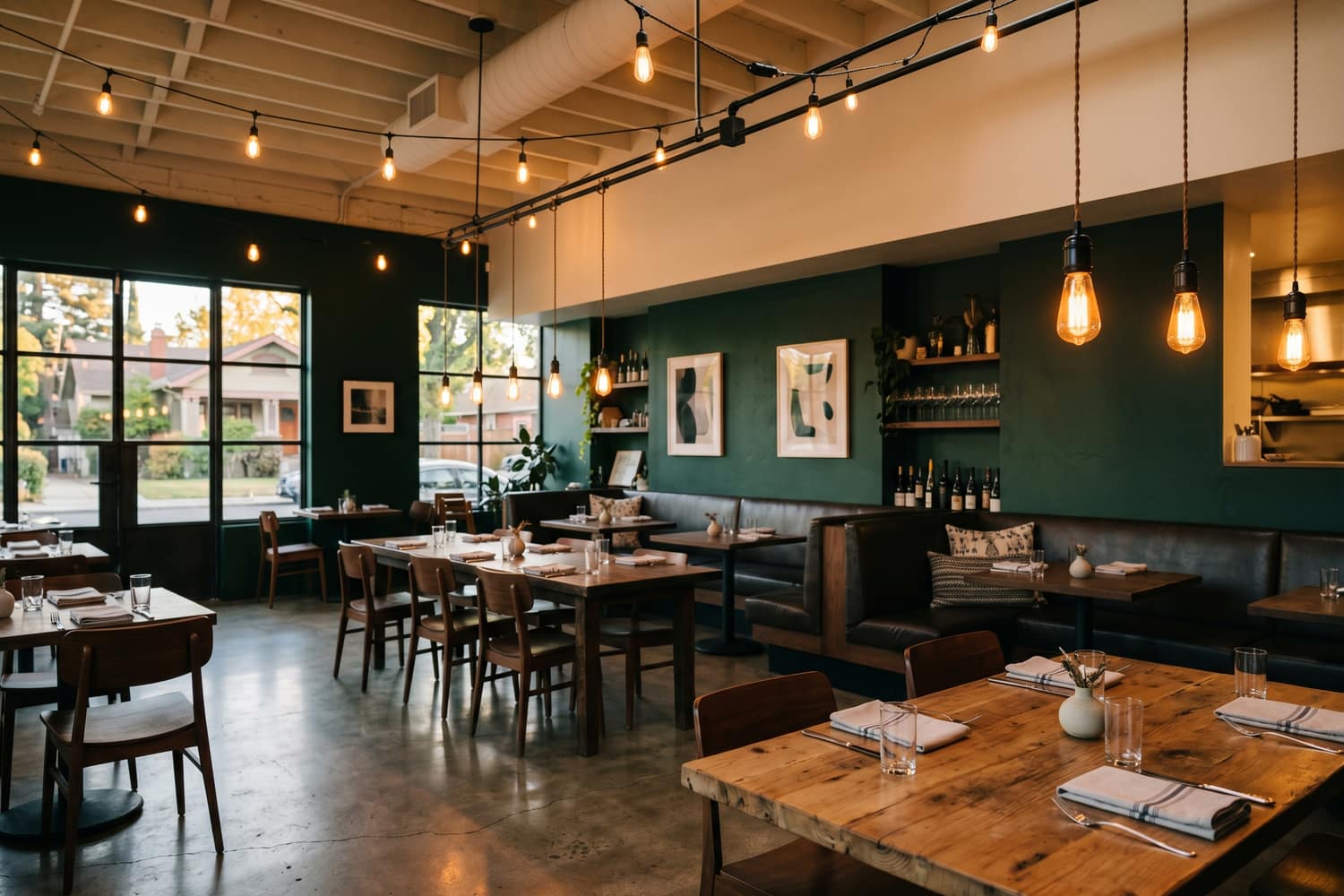
Restaurant painting in Sacramento must meet specific California Retail Food Code (CalCode) requirements: walls and ceilings in food prep areas, warewashing rooms, and restrooms must be smooth, nonabsorbent, light-colored, and easily cleanable. Most full-service restaurants in the Sacramento metro spend between $4,500 and $18,000 on a complete repaint, and the work almost always has to happen overnight or during a planned closure to satisfy Sacramento County Environmental Management Department inspectors.
That is the short version. The longer version involves which finishes pass health inspection, why epoxy is sometimes required behind the line, how to schedule the project around dinner service, and what the consequences look like when a restaurant tries to cut corners on the wrong wall.
This guide covers the CalCode rules that drive every paint decision in a food facility, real Sacramento pricing, the products that survive a commercial kitchen, and a scheduling framework built for operators who cannot afford to lose a Friday night.
What Does Sacramento County Health Code Actually Require for Restaurant Paint?
The rules come from the California Retail Food Code, also called CalCode, which Sacramento County Environmental Management Department enforces during routine and pre-opening inspections. The relevant sections are Cal. Health and Safety Code 113953 through 114268. The language is dry, but the practical requirements break down cleanly.
Food prep areas, warewashing, and walk-ins must have:
- Smooth, nonabsorbent, durable wall and ceiling surfaces
- Light-colored finishes that show dirt and contamination
- Easily cleanable construction with no porous materials
- Sealed transitions between walls, floors, and ceilings (coved bases where required)
- No flaking, peeling, or chipping paint anywhere food, utensils, or food-contact surfaces are exposed
Restrooms, employee changing areas, and janitorial closets must have:
- Smooth, nonabsorbent, easily cleanable wall and ceiling finishes
- Moisture-resistant paint capable of withstanding daily sanitizing
Dining rooms have looser requirements but still need to be maintained in good repair. Peeling paint, water stains, and visibly damaged walls can trigger violations during inspection.
Citation capsule: California Retail Food Code Section 114268 requires that walls and ceilings of food facilities be "durable, smooth, nonabsorbent, and easily cleanable" in food preparation areas, warewashing areas, and toilet rooms (California Department of Public Health, CalCode, 2024).
The key phrase across all of it is "easily cleanable." Flat latex paint over porous drywall is not easily cleanable. Eggshell on a kitchen wall behind a fryer is not easily cleanable. The finish has to take pressure washing, sanitizer chemicals, grease cutters, and daily wipe-downs without breaking down. That single requirement drives every product and pricing decision in restaurant painting.
Best Paint for Restaurant Walls: Finish by Zone
Different areas of a restaurant need different products. Using the wrong finish in the wrong zone is the fastest way to fail an inspection or repaint the same wall a year later.
| Zone | Required Finish | Typical Product Type | Why |
|---|---|---|---|
| Cookline / behind equipment | High-gloss epoxy or urethane | 2-part epoxy (Sherwin-Williams Pro Industrial, Benjamin Moore Corotech) | Withstands grease, heat, daily degreasing |
| Prep tables / cold side | Semi-gloss acrylic latex or epoxy | Sherwin-Williams Pro Industrial Pre-Catalyzed Epoxy | Easily cleanable, sanitizer-safe |
| Walk-in coolers | Mold-resistant epoxy | Cold-storage rated epoxy | Resists condensation, prevents mold growth |
| Warewashing room | High-gloss epoxy | 2-part waterborne epoxy | Constant moisture and chemical exposure |
| Restrooms | Semi-gloss or high-gloss acrylic | Bath / kitchen rated paint | Moisture and sanitizer resistance |
| Dining room walls | Eggshell or satin acrylic | Premium washable interior latex | Easily cleanable, hides minor wear |
| Dining room ceilings | Flat or matte ceiling paint | Standard ceiling paint | Low traffic, no health code restriction |
| Bar back / prep zones | Semi-gloss or epoxy | Pre-catalyzed epoxy | Spills, stains, daily wipe-down |
Flat paint has no business in any food prep, warewashing, or restroom zone. It absorbs grease and moisture, traps bacteria in its porous surface, and breaks down the moment a line cook hits it with a sanitizer rag. If your current paint dulls or marks when wiped, it is not code-compliant and needs to be replaced.
For the front of house, see our paint sheen guide for a deeper breakdown of where each finish belongs.
Restaurant Painting Cost in Sacramento: 2026 Pricing
Sacramento restaurant painting costs vary by square footage, the mix of zones, surface condition, and how much of the work has to happen after hours. Here are realistic ranges based on current market rates.
| Restaurant Size | Square Footage | Front-of-House Repaint | Full Interior + Kitchen |
|---|---|---|---|
| Small cafe / coffee shop | 800-1,500 sq ft | $1,800-$3,800 | $4,500-$8,500 |
| Quick-service restaurant | 1,500-2,500 sq ft | $3,200-$6,500 | $7,500-$14,000 |
| Full-service restaurant | 2,500-4,500 sq ft | $5,500-$11,000 | $12,000-$22,000 |
| Large casual dining | 4,500-7,000 sq ft | $9,500-$18,000 | $20,000-$38,000 |
| Bar / lounge / nightclub | 2,000-5,000 sq ft | $4,500-$13,000 | $10,000-$26,000 |
Sacramento commercial painting averages $1.45 per square foot for standard interior work (Homeyou, 2026), but restaurant projects sit higher because of the specialized products, more demanding prep, and after-hours scheduling premium. Budget $1.50 to $3.50 per square foot for code-compliant restaurant interior painting, and $4 to $7 per square foot for kitchen epoxy zones.
For a broader look at commercial pricing across building types, see our commercial painting cost guide.
What Drives Restaurant Painting Costs Up
Several factors push restaurant projects above standard commercial rates:
- Epoxy and urethane coatings. These cost two to three times more than standard latex per gallon and require longer dry times between coats.
- Surface prep on grease-soaked walls. Cookline walls need degreasing, washing, and sometimes priming with a stain-blocking product before paint will adhere.
- Overnight scheduling. Most painters charge a 15 to 30 percent premium for after-hours work to cover labor differentials and split crews.
- Furniture and equipment moving. Booths, tables, dish racks, and prep tables all have to be moved and protected.
- Floor and equipment protection. Stainless steel, hood vents, gas lines, and finished floors all need careful masking.
- Coordination with health inspector. Some major remodels require pre-approval and post-completion inspection from Sacramento County Environmental Management.
What Brings Costs Down
- Painting only the front of house and leaving the kitchen for a separate phase
- Scheduling during a planned closure (Mondays for many Sacramento restaurants)
- Using pre-catalyzed waterborne epoxy instead of two-part solvent epoxy where conditions allow
- Bundling restaurant painting with other eco-friendly painting work in low-VOC products that meet both code and air quality requirements
- Maintaining a regular repaint cycle so each project requires less prep
Can You Paint a Restaurant While It Is Open for Business?
Yes, but only the dining areas, and only with specific products and ventilation. Anything inside a food prep zone, warewashing room, or behind the bar usually requires the restaurant to close that section while the work is happening. CalCode prohibits food preparation in any area where active painting, dust, or solvent fumes can contaminate food or food-contact surfaces.
Here is how Sacramento operators typically handle each zone:
-
Dining room walls and ceilings: Painted overnight after closing, dry by morning service. Low-VOC waterborne products eliminate fume issues. Furniture is moved to one side of the room, then swapped the next night.
-
Bar areas: Painted overnight or during a Monday closure. All glassware, bottles, and bar tools are removed or sealed in plastic before work starts.
-
Restrooms: Painted overnight one at a time, with the other restroom kept in service. Waterborne semi-gloss dries fast enough for next-day use.
-
Cookline and kitchen walls: Require the kitchen to be fully shut down. Most Sacramento restaurants schedule this during a Monday or Tuesday closure, or during a planned 2-to-3-day deep clean. All food and utensils must be removed or covered, hoods are masked, and gas lines are protected.
-
Walk-in coolers: Require the cooler to be emptied and warmed up before painting. Schedule during slow seasons when food inventory can be reduced.
-
Warewashing rooms: Closed for one shift while paint dries. Disposable plates and utensils carry the operation through the closure.
The full closure requirement for kitchens is the single biggest scheduling constraint. Most ProFlow restaurant clients in Sacramento and the Bay Area choose Sunday night through Tuesday morning for kitchen work, which gives a 36-hour window with minimal revenue impact.
Sacramento & Placer County
Need a real quote on your project?
Free, no-obligation walkthrough. Itemized estimate within 24 hours. Most jobs scheduled within 2–3 weeks.
Restaurant Repaint Frequency: How Often Do Restaurants Need Painting?
Restaurants wear faster than any other commercial building type. A busy dining room sees thousands of customers per week, the kitchen takes constant abuse from grease and steam, and health inspectors expect every visible surface to look maintained. Here is a realistic Sacramento schedule by zone:
| Zone | Repaint Frequency | Why |
|---|---|---|
| Cookline / behind equipment | Every 12-18 months | Grease, heat, daily degreasing |
| Prep areas / cold side kitchen | Every 18-24 months | Constant cleaning, moisture |
| Warewashing room | Every 12-18 months | Steam, chemicals, splash |
| Walk-in coolers | Every 24-36 months | Mold growth, condensation |
| Restrooms | Every 18-24 months | High traffic, daily sanitizing |
| Bar / bar back | Every 24-36 months | Spills, lighting reveals wear |
| Dining room walls | Every 24-36 months | Customer wear, scuffing |
| Dining room ceilings | Every 5-7 years | Low touch, only smoke and dust |
| Exterior building | Every 5-8 years | Sacramento sun, wear from signage |
These numbers run shorter than the commercial painting maintenance schedule for offices and retail because food facilities operate under harsher conditions and tighter cleanliness standards. A restaurant that tries to stretch a kitchen repaint to four years almost always fails inspection or develops paint failures that force an emergency project at higher cost.
How CalCode Inspections Actually Work in Sacramento County
Sacramento County Environmental Management Department conducts routine inspections at restaurants one to three times per year, plus complaint-based and pre-opening inspections. Paint condition shows up in the inspection report under several categories:
- Physical facilities maintained and clean (Section 114256)
- Walls, ceilings, attached equipment in good repair (Section 114268)
- Floors and walls free of cracks and holes (Section 114268)
Common paint-related violations Sacramento inspectors write up include:
- Flaking or peeling paint above food prep surfaces
- Water-stained or mildewed ceiling tiles in dining or kitchen areas
- Porous wall finishes (flat paint) in warewashing or prep zones
- Damaged or missing coved base where required
- Exposed drywall or substrate in food zones
Violations are generally categorized as Major or Minor. Paint and surface violations are usually Minor on first observation but become Major or trigger reinspection fees if not corrected within the timeframe given (typically 30 days). Repeat violations can affect the restaurant's letter grade and show up on the public-facing inspection database.
The Restaurant Painting Project Timeline
Most Sacramento restaurant painting projects break down into a predictable timeline. Here is what to expect from quote to final walk-through:
-
Site walkthrough and scoping (Day 1). Painter identifies each zone, measures square footage, checks substrate condition, and notes which areas need epoxy versus standard paint.
-
Written estimate (Day 2-3). Itemized bid by zone, with separate line items for prep, primer, paint, equipment moving, and after-hours premium.
-
Color and product approval (Day 4-7). Owner selects light-colored finishes for code zones and brand colors for dining areas. Painter pulls samples and test patches.
-
Scheduling coordination (Day 7-10). Painter and operator confirm closure windows, deliveries, and crew arrival times. Health department notification if required for major work.
-
Prep work (Night 1). Move furniture, mask equipment, degrease walls, repair drywall damage, sand glossy surfaces, prime stains.
-
Paint application (Nights 1-3). Cut in, roll walls, spray ceilings where appropriate. Two coats minimum for code compliance.
-
Touch-up and walk-through (Final morning). Operator inspects each zone with painter. Punch list items completed before crew leaves.
-
Cleanup and equipment return (Final morning). Furniture restored, masking removed, floors cleaned, ready for service.
For a typical 3,000-square-foot full-service restaurant in Midtown Sacramento, this entire process runs 10 to 14 calendar days from initial call to project completion, with the actual paint work happening over 2 to 4 nights.
Frequently Asked Questions
What paint is required for restaurant kitchens in Sacramento?
California Retail Food Code Section 114268 requires kitchen walls and ceilings to be smooth, nonabsorbent, durable, light-colored, and easily cleanable. In practice, this means high-gloss epoxy or urethane coatings on cookline walls, semi-gloss acrylic or pre-catalyzed waterborne epoxy on prep zones and walk-ins, and high-gloss epoxy in warewashing rooms. Flat or eggshell paint does not meet code in any food prep area.
How often do restaurants need to be repainted?
Restaurant kitchens and warewashing rooms typically need repainting every 12 to 18 months because of constant cleaning, grease exposure, and sanitizer wear. Dining rooms last 24 to 36 months, restrooms 18 to 24 months, and exterior building paint 5 to 8 years in Sacramento's climate. High-volume restaurants on the higher end of these ranges almost always trigger health code violations or visible wear before the cycle ends.
What are Sacramento County health code painting requirements?
Sacramento County enforces the California Retail Food Code, which requires food facility walls, ceilings, and floors in prep, warewashing, and toilet areas to be durable, smooth, nonabsorbent, and easily cleanable. Paint must be in good repair with no flaking, peeling, or visible damage. Light colors are required in food zones to make contamination visible. Violations can result in points on your inspection score, reinspection fees, and impacts to your public-facing letter grade.
Can you paint a restaurant while open for business?
Dining rooms can usually be painted overnight while the restaurant remains open, using low-VOC waterborne products that are dry by morning service. Kitchens, warewashing rooms, and food prep areas require the restaurant to be fully closed during painting because CalCode prohibits food preparation when active painting, dust, or fumes can contaminate food-contact surfaces. Most Sacramento operators schedule kitchen painting during Monday closures or planned deep-cleaning windows.
How much does it cost to paint a restaurant in Sacramento?
Sacramento restaurant painting runs $1.50 to $3.50 per square foot for standard interior work and $4 to $7 per square foot for kitchen-grade epoxy coatings. A small cafe repaint typically costs $4,500 to $8,500, a full-service restaurant runs $12,000 to $22,000 for a complete interior, and large casual-dining concepts can reach $20,000 to $38,000 for full interior plus kitchen work.
What is the best paint for a commercial kitchen wall?
The best paint for commercial kitchen walls is a two-part epoxy or pre-catalyzed waterborne epoxy in a high-gloss or semi-gloss finish. Sherwin-Williams Pro Industrial Pre-Catalyzed Waterborne Epoxy and Benjamin Moore Corotech are widely used in Sacramento restaurants because they meet CalCode requirements, resist grease and chemicals, and clean easily. These products cost more upfront than standard latex but last two to three times longer in commercial kitchen conditions.
Do I need a permit to paint a restaurant in Sacramento?
Standard interior repainting does not require a building permit in Sacramento, but if the work is part of a tenant improvement, includes significant drywall repair, or alters food prep areas, the project may need to be reported to Sacramento County Environmental Management Department. Major remodels almost always require a plan check and reinspection before reopening. When in doubt, ask your painter and your county inspector before starting.
Schedule Your Restaurant Painting Project
Restaurant painting in Sacramento is not standard commercial work. It involves specific health code requirements, specialized products, after-hours crews, and tight coordination with operations. Getting it right protects your inspection grade, your repair budget, and your customer experience.
ProFlow Painting works with restaurant operators throughout Sacramento, the Bay Area, and surrounding communities. We handle full-service restaurant repaints, cookline epoxy projects, dining room refreshes, and pre-inspection touch-ups, scheduled around your service hours so you do not lose a single shift you do not have to. Get a free restaurant painting estimate and we will walk your space, identify any code-related issues, and build a project plan that fits your operation.
Free quote · Sacramento & Placer County
Ready for a real estimate, not a guess?
Tell us about your project and we'll walk it with you in person. Itemized quote within 24 hours, no high-pressure sales.